Wednesday, August 16, 2017

Apoc-eclipse at CircusK9

So on the way home from the store, where I was stocking up on food in advance of the coming apoc-eclipse, I heard on the radio that gas stations in Bend, Oregon, are already running low on gas. Bend is not in the path of totality but it is one of the larger towns in eastern Oregon near that path.
Let's let that sink in a bit. It is Wednesday. The solar eclipse, an event that will last all of a couple of minutes, won't happen until Monday (four days and 19 hours from now according to NASA's countdown clock). The hordes are now descending on Oregon by the tens of thousands, projected to increase to over a million people by Monday. There are only about 4 million of us in the entire state to begin with so that's a lot of extra people: extra mouths, extra cars, extra butts. I read some local news articles about the astonishingly large number of portable toilets that were rented for the occasion by various towns and cities to help reduce the number of people shitting and pissing in Oregon waterways and beaches and deserts.


I live in a town in west Oregon that is in the projected path of totality for the eclipse. I'm treating this like a natural disaster, and stocked up on dog and cat food, cat litter, food for myself, extra water, and of course, gas for the car. I plan to hunker down at home. After hearing the radio reports on the way home from the store, I may go buy a gas container and some extra gas this afternoon.

Don't get me wrong, I fully appreciate the scientific impact of this event, unusual in that the path of totality crosses the entire continent. I saw about 75% of a full solar eclipse in 1990 in Austin, Texas. It was pretty neat. Following instructions on a NASA JPL site, I made a simple pinhole camera so I can safely watch this one. Emphasis on simple, that's for sure. I will certainly celebrate this astronomical event on Monday. But I plan to do it in the calm and quiet of my own backyard.

Tuesday, August 15, 2017

Azza, My Delicate Little Flower

At the end of the spring term, Azza and I were bouncing back and forth between her regular vet and the emergency vet clinic. It was an expensive round of visits. I've always been worried about how to handle Azza if she got sick. Well, I got a chance to find out.

She doesn't allow many people to touch her even when they are here in the house and she's seen them several times. There are some visitors that she quite likes but she is selective. Even though I muzzle her before we enter an exam room, it takes a vet with a calm and sure hand to even get close enough to listen to her heart and lungs, or dog forbid, touch her as part of a physical exam. Forget about that rectal temperature business. Not happening. So when she began to vomit blood and pass fresh blood and mucus instead of stool, my first thought was how to manage the inevitable vet clinic visits. It really helps that I have continued to introduce her to new things (agility trials, for example, which she only views from afar but that is quite enough for her) and to new people. During our various vet visits, it was of course necessary to draw blood for testing, and she would have to be touched by at least one other person besides me. I would muzzle her and hold her, instructing techs that they had one shot so bring all the tubes they think they might need. On one visit to the emergency clinic, the tech brought in five vacuum tubes of various sorts. I laughed and said, she'll be light headed after you pull that much blood out of her (not really, but it's a good vet med joke). 

Her symptoms were frustratingly non-specific: episodic inappetance, vomiting, and bloody stool every few months over a period of a couple of years that suddenly and dramatically increased in frequency and severity. I acted so quickly when things got bad that she wasn't even dehydrated yet. Coming up with a definitive diagnosis was difficult. Lots of things had to be considered and ruled out: pancreatitis (she did in fact have acute pancreatitis but it was secondary to the real problem), Addison's or hypoadrenocorticism, parasites, ingested toxins, even salmon poisoning (which isn't from the salmon but from the Neorickettsia bacteria that lives in flukes that infect the liver of the salmon), and so forth.

We eventually came up with a presumptive diagnosis: IBD, irritable bowel disease caused by food allergy and an out-of-control auto-immune response. It's presumptive because a definitive diagnosis would have required a biopsy of her colon. I did not want to subject her to that procedure. Somehow, even though her symptoms were pretty severe, we managed to give her temporary relief without ever hospitalizing her.

This IBD is particularly pernicious because her own immune system is attacking the digestive epithelial cells that line her gut. Fortunately, medical diets for our companion animals have become quite sophisticated, and it turns out that we were able to resolve her problems by switching her to a hydrolyzed protein diet. Although Hill's makes one called z/d, and the terriers are thriving on Hill's Ideal Balance kibble, I chose to feed Azza Royal Canin's Ultamino. Proteins in the hydrolyzed diets, usually chicken, are broken down from very long chains of amino acids into small groups of a few or even just singlet amino acids. That's what happens in your gut when you eat chicken: your pancreas releases proteases that break the chains into smaller and smaller pieces, eventually breaking them down into individual amino acids which pass into your gut epithelial cells. Azza's body doesn't have to do that now. Her gut doesn't even register these little bitty groups of amino acids as "chicken" so she can eat protein without triggering an auto-immune response. 

Her improvement upon switching to Ultamino was amazing. We had her on quite a few drugs to calm her gut down but those were all finishing up just as I started her on the new diet. She loves the taste of the kibble and eats it with gusto. Her symptoms resolved in just a few days. She's been through most of a 25-pound bag now and I was relieved that she was doing so well.

She was doing well until I gave her a new flea treatment last night. See, fleas are becoming resistant to fipronil, the active ingredient of Frontline. I've used Frontline for years but I knew that I was rolling the dice since fipronil-resistant fleas were becoming more widely reported in Oregon. And sure enough, those little fuckers showed up in my back yard. So after doing some research, I decided to switch the dogs to Nexgard. It uses a different chemical to kill the fleas (afoxolaner), and it is an oral medication (Frontline is a topical). 

I gave each dog a Nexgard chewable last night after dinner. Within one hour, Azza was scratching her belly, neck, and head incessantly, chewing on her skin on her legs, and had a head tilt and was shaking her head constantly. Her neck, chest, belly, and inside her ears were bright, inflamed red. I managed to get her to her regular vet this morning (saving the emergency clinic visit fee) just as her scratching began to break her skin. She got a diphenhydramine shot (you know it as Benadryl) plus some prednisone. Since she'd never had antihistamines before, I was curious to see how she would react. It will either makes dogs sleepy or it will make them hyper (same for people too). Turns out it makes her sleepy. I'm now giving her diphenhydramine orally every 8 hours. Combined with the prednisone, her symptoms have become greatly reduced. Not gone, she is still scratching and licking but it's not as frantic, and her skin is not so red (ah, the immune-suppressing magic of corticosteroids). Her head tilt and head shaking seems to be gone. If I can keep her quiet, she sleeps. 

So what caused this allergic reaction? It could have been the beef flavoring since we know she has problems with proteins, it could have been the coloring agents, it could have been the medication itself. All I know is that I am switching back to a topical flea treatment (I'm looking into Activyl, which has a completely different chemical that disrupts the life cycle of the fleas; fipronil and afoxolaner are flea neurotoxins). Nothing more by mouth for this delicate little flower!

Monday, August 07, 2017

Archie the Agility Monster

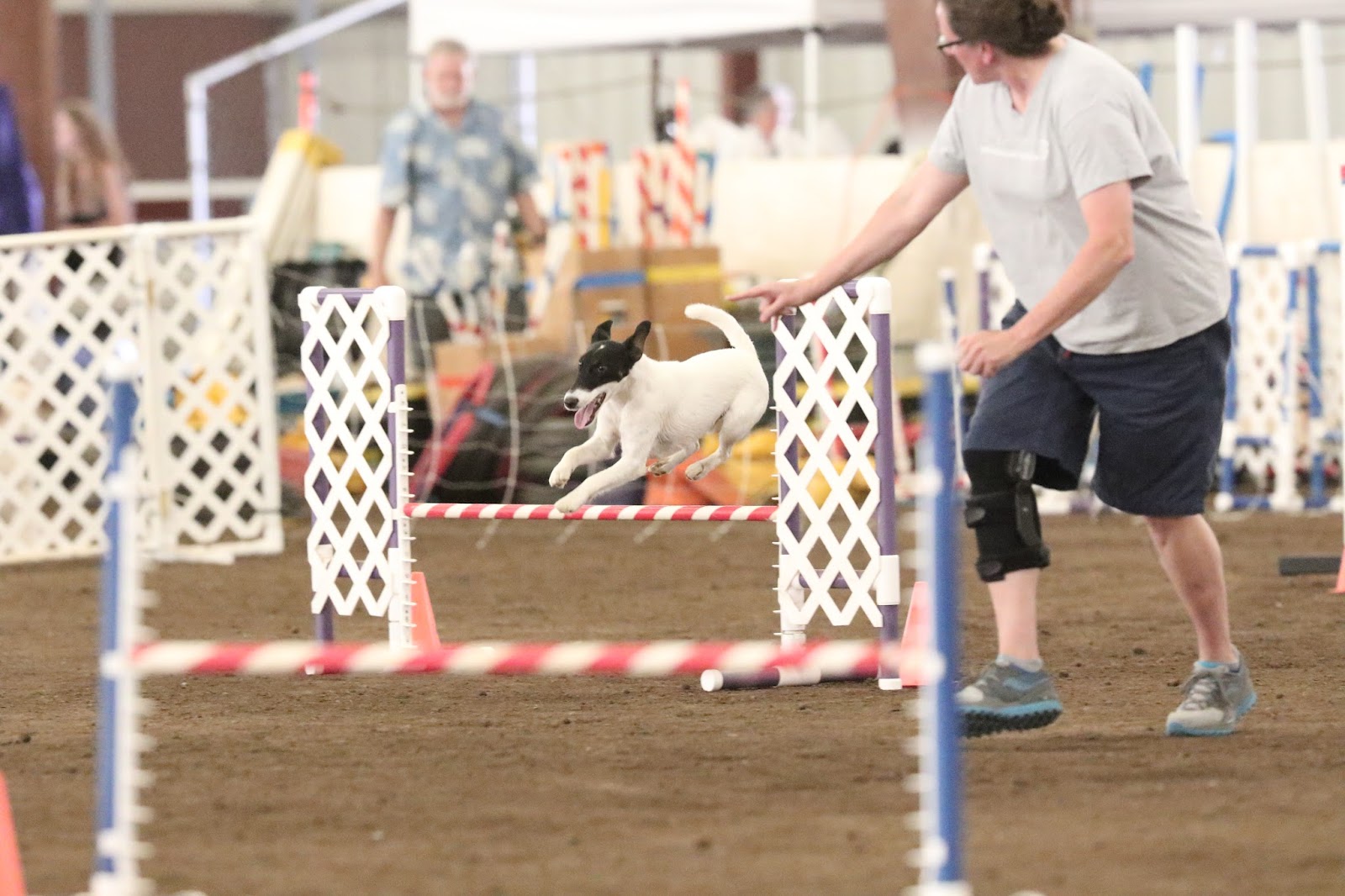
I've not put up an agility update in a while. I only trial at venues along the Oregon I-5 corridor. Even so, the AKC circuit is pretty active in Oregon so there have been plenty of opportunities for Archie and I to explore our relationship in the ring. He's now in the Excellent classes for both Standard and Jumpers. That's quite an accomplishment for a pup who is not yet 2 years old, whose first trial was in late December. In fact, he earned his first Excellent Q, in Jumpers, on Sunday. He even placed first in the 16" class--a truly amazing win.

Archie often takes a little hop at the last weave pole. It doesn't seem to slow him down.
Both of us are learning. If I am excited and tense, he is all over the place, blowing contacts and boinging over jumps. The latter is crowd pleasing to be sure but it is stylistically and energetically shit. When he starts boinging (running up to a jump then levitating over it), he is far more likely to knock bars. On Saturday, he took out entire jumps, wings and all, in his Standard run. Sigh. At least he was having a good time. 

No boinging here. Still having a good time.
If I am calm, able to give calmly voiced commands early and clearly, he runs very well indeed. I was a bit stressed on Saturday when I realized that I was finally running alongside all of the people that I usually watch in admiration and awe, and my mental state affected our runs (thus boinging, thus many knocked bars). On Sunday, I did my best to stop thinking about that. And it showed--placing first in Jumpers was our reward. Even with a short diversion away from the course to check out...I have no idea, really, it's Archie, it was his puppy terrier brain...he still beat experienced dogs of all breeds for that placement.

Laser eyes on the triple ahead.
I am learning to trust him. He is starting his runs more and more like he does in class--excited, focused. I have stopped choking up on the lead as we enter the ring, afraid that he'll run off when I remove it. I take it off as soon as the other dog is safely out of the ring then I play with him a bit before I send him to the first obstacle. No start line stay for this pup. He wants to be fired up then go go go. I am becoming much less worried that he will leave the ring during a run. That doesn't mean that he won't leave the ring, it just means I am getting less worried about it.

I love this picture. Every single muscle in his body is engaged. He's a lovely dog.

More and more, the dog that I see in class is the dog I have in the ring. 

(All the photos in this post are from a trial in July. My favorite photographer Joe Camp was there and I bought all the pics he made of Archie. Nice photos and very fair prices. Judging by the lines of people wanting to buy photos from him, I'm not the only one who thinks this.)

Tuesday, August 01, 2017

Diary of a Third-Year Vet Student: The Clients In Front of Us

I'm doing a bit of shadowing this summer at the clinic I worked in a couple of summers ago. I've got my research project to finish up and it takes first priority, but I figured I could put in a bit of time to learn more about the kinds of vet things they never teach you in school. For example, I was observing a vet rinse out an abscess from the abdominal cavity of a rat. It was a rather spectacular operation because she ended up getting 46 g of pus out of that abscess (weight of rat before operation: 446 g, weight of rat after operation: 400 g). Pus fountains galore! 

I noticed she was using dilute betadine solution to rinse out the abscess, which was by this point completely walled off from the rest of the rat's abdominal cavity by fibrous tissue, as is normal for an advanced abscess like that one. I have seen other operations in which rinsing out wounds would be done with dilute chlorhex solution. Once she finally determined there was no more pus to be had and she had closed the incision (mainly done with skin glue since rats are known to self-harm and would pull any sutures out--no reliable e-collars for rats!), I asked her about her criteria to determine when she used betadine and when she used chlorhex for lavage. She told me that she uses betadine for anything involving serosal membranes in the gut (i.e., exposed visceral surfaces) or mucous membranes in the eye, vulva, prepuce, or mouth. Lacerations and things like that could be rinsed with either solution. That same night I also learned that for the purposes of anesthetic monitoring of heart rate, temperature, and blood pressure, ferrets can be treated as tubular cats. 

In just that one night I learned a handful of very useful things that I will never learn in school. Well worth a few hours of my time.

There are of course many aspects to being a good vet beyond knowing which suture to use (or not) or memorizing dosages of the erpy dog drug trifecta (maropitant, famoditidine, sedative or analgesic of choice). I am pretty sure that I posted a story on the blog about the Kale Vet who was recommending a raw bone-raw meat-kale diet to two homeless people to help their dogs who had some really itchy skin issues. She was not treating the client or the patient in front of her but some sort of Ideal Client. I was reminded of that again last weekend.

I spent most of my evening working with a couple, man and woman, who had brought their rat in for euthanasia. The rat was 2 1/2 years old, already pretty old for a rat. He was having seizures, hypersalivating, had become paralyzed in his hind legs and had lost bladder and anal sphincter control. The vet introduced me as a vet student and had me examine the rat. Our diagnosis was neurological, probably a tumor, probably pressing on the spinal cord or brain or both. It's a common thing to see in older rats.

The man was overweight, dressed in baggy, saggy, stained pants and wearing a stained white Tshirt, an undershirt really. The woman was overweight, had long, straggly blonde hair, angry, spotty skin, and was wearing a black miniskirt and a light blue top that was far too tight for her.

How easy it is to judge, isn't it? I fell right into that trap. I am ashamed to admit that, at first, I failed to interact with the client in front of me.

But they loved their rat deeply. They had watched him all day getting progressively worse and they knew that it was probably time to let him go, even though they had a tiny bit of hope that it might be treatable. The couple wanted to be there with the rat, so once we injected the pentobarbital (intraperitoneal injection), I took the rat back to them. And because I know it is not a good idea to leave clients alone in that situation, I gave them privacy but I checked in often. 

When I would go in and examine the rat, cradled in a towel in her arms, they would tell me stories about the rat, about the silly things he did, about his daily routines. I asked them questions about what rats eat and how he interacted with other animals. I learned that he had a specific type of coloring called "siamese" which gave this white rat with pink eyes a brown stripe on his nose and another above his tail (it's a real thing). As we talked, I began to see them, really see these clients and this patient in front of me. They were able to laugh even in their grief because their rat had had a pretty joyful life. They knew a lot about rat behavior and were willing to share that with me.

And I was reminded about how important it is to interact with the clients and patients I have right now, right in front of me. I never want to become the Kale Vet, oblivious to all but her own woo and her own agenda.

Before they left, when the vet was in the room, the woman turned to me and said, "I'm so glad you are going to be a vet. You will be a credit to the profession."

I did fall into the Kale Vet trap and I am ashamed that I did but I managed to correct my path before I failed those clients and that patient.

Sunday, July 16, 2017

Archie the Snake Killer

I have had resident northwestern garter snakes in my yard since I moved in. They live in the cool crawl space under my house, and I think that they dig into the dirt there to overwinter. I've seen them in all sizes so I know that they reproduce too. I am careful to avoid them when mowing--they like to bask in the sun in the mornings and don't always move out of the way without a nudge. Northwestern garter snakes aren't particularly large, they aren't aggressive or poisonous, and although sadly they eat up all the toads, they also eat slugs and other creatures that I would rather not have in my yard. I keep deep bark mulch around all my bushes and flowering plants and the snakes like to hang out in the loose mulch around the base of the larger ones. In short, they have fairly predictable behaviors and routines like any other animal.

Northwestern Garter Snake.

Because he is a fox terrier, Archie is extremely alert to movement. The snakes attract his attention immediately. He is also quite smart, and he has figured out their routines and behaviors just like I did.

Archie hunts those garter snakes. He lurks around the larger bushes or systematically searches through larger sunny patches. And when he finds one, he kills it by grabbing it behind the head and shaking the life out of it. He whips those poor snakes so fast that blood comes out of all of their orifices. He then guards the dead snake for a few minutes--I've seen him snap at Mimi to chase her away from his precious prize--but he eventually loses interest and heads off to look for more trouble elsewhere.

Here he is with snake blood on his shoulders and paws (he gets it on both sides and on his head but you only need one gory photo as evidence). He doesn't roll on the snakes. This blood is from the snake smacking into him as he whips it back and forth.


I keep part of the yard fenced off so the snakes have a safe space to cavort, but they insist on coming into the main yard where Archie inevitably finds them. While I am sad for the snakes, there is not much else that I can do to protect them. And Archie is acting like a fox terrier is supposed to act. Other than giving him a bath afterwards, I don't intervene. In fact, I'm rather impressed with his dedication to this activity.

Archie the Snake Killer. It would make a good tattoo!

Sunday, June 25, 2017

Archie and The Purgatory of Open

Open is what AKC calls the intermediate agility level. As a friend remarked to me, Open courses aren't really designed, they are what is left over after you take away an obstacle or two from the Excellent/Masters class. Sadly, this is very true.

Open classes in this part of the US are usually quite small, often no more than 12 or 15 dogs from all height classes combined. Archie was the only dog in his height class for most of the weekend.

Some dogs zoom through Open, advancing in just a trial or two to Excellent. After all, to successfully complete Open courses, a dog has to already have Excellent-level performance skills. But because you don't have to many skills at all to get there, other dogs spend quite a bit of time at the Open level. Open has a bit of a reputation for accumulating dogs who just aren't going to do well in agility. On Friday, the judge welcomed us to the "purgatory of Open"--and she wasn't really joking. There are many reasons that a dog may need to stay in Open for a while: dogs may be physically structured such that agility will never be a good fit for them, some dogs just don't like the game and their handlers haven't figured that out yet, handlers and dogs may not yet have the skills they need to succeed, and so forth.

Given how well Archie performs in class, I assumed his time in Open would be brief. But we've now been in Open for four trials and only had four Qs out of a total of 14 runs at this level; this weekend we were 0 for 6.

I was feeling quite frustrated yesterday. But I realized today that I was missing something very important. It wasn't really the heat, although that may have been a factor. Archie simply isn't ready to advance to Excellent yet. His head is not yet in the game.

Ironically, I started the weekend worrying about something completely different. This was our first time at this particular venue. It is an open, dirt-floored horse arena. The fencing is even less complete than at most other places, and the arena itself doesn't even have walls all the way around. There were places where there was nothing more than horse railings separating the dogs from the enormous and exciting world outside. Horse railings with the lowermost bar almost 18" from the ground, hardly a barrier at all to a dog the size of Archie. He already demonstrated that he could get through the usual plastic fencing. I was sure he'd take one look at that horse railing and dive under it and be gone.

Yes, I have a young terrier who I don't trust off-leash. Judge away. I'm sure some of my agility-savvy readers are thinking, then why are you doing agility with him? Well, I don't like to stereotype breeds but...I'm going to revert to a stereotype: terriers are really difficult dogs to manage off-leash. The thought of unhooking my dog from a leash is terrifying. It's like Pandora's box--I have no idea what might happen, although all that I imagine is pretty horrible.

The irony is this: Archie never even glanced at the horse railing. I don't think he even noticed they were there. What he did notice was the hot dogs that a competitor left on a dolly outside the ring. He could barely function inside the ring, pulled magnetically toward those hot dogs after every obstacle. I gave up fighting him halfway through that run and carried him out of the ring. Today, he noticed that someone had eaten takeaway pizza and had left the box outside the ring on the ground. I literally forced him to complete that run. He had so many refusals and other errors while trying to figure out if he could leave the ring to get to the pizza box that we lost the Q quite early on. Our standard run earlier today was so bad that at one point the judge said "I don't know what errors I am supposed to call now!" (Archie had just gotten on the teeter, immediately turned around and did a perfect two-on-two-off contact on the entrance to the teeter, thus failing to execute the teeter and calling the "four-paw rule" into play. It was a clusterfuck.)

So I learned some hard lessons this weekend. The good news is that my pup will come back to me when I call. The bad news is that he will run off if he smells even a molecule of something delicious that he thinks he might be able to get to. Agility itself is not yet enough of a reward that he will choose that first.

I told Archie that I will be ready when he is ready. And I have some plans to help him along. He will be running agility with an increasing number of distractions (think plastic containers with food that he can't get to). He won't get high-value treats on course anymore--those will only come after he is leashed and we return together to his crate. I love my fabulous puppy very much, and am frustrated that he is so young and naughty. But I am glad that I was able to take a step back and recognize that we need some more training.

As a friend remarked this afternoon, when he's on, he's brilliant. Yes, but his moments of brilliance are not yet course-length in duration. We'll get there. I'm sure of it.

Sunday, June 18, 2017

Archie and His Orbee

I mentioned one of Archie's sillier behaviors in a recent post: how he lays down with his front paws straight out in front of him, side by side, and then carefully sets the ball on his paws and nudges it with his nose, using his paws like a piece of Hot Wheels track to direct the ball to me. He's learned, of course, that he has to be more or less facing me or this trick won't work. I refuse to chase balls so one of his newer commands is "no, YOU get it!" 

I'm now going to attempt to describe some other unique aspects of playing ball with Archie. I have to specify that we prefer to play with the Orbee balls patterned like globes. The dogs gleefully and immediately peel off the continents when given a new Orbee ball, which is rare because they last forever (rated 10/10 by T3i), but even without those decorations the balls are satisfyingly knobbly. Iceland in particular is alarmingly large and pointy. The balls are made of soft rubber (not latex), and have two holes in them at opposite ends. The part about the holes is important, as you will see. 

Archie likes to chew on his ball a bit before he rolls it off his paws to me. But he doesn't just mouth it. He rapidly compresses this thick, strong ball nearly in half with his giant fox terrier teeth and jaws. Now imagine what happens when you do this with a hollow rubber ball--all the air rushes out the holes and puffs his cheeks out. Then he relaxes his jaws and the ball pops back to shape as the air rushes back in, sucking his cheeks with it. He often gives a terrier head shake when he clamps down just to make really sure the ball is dead. He will do this more than a dozen times in a row after every throw so I can only conclude that he likes how it feels. His actions are deliberate, not frantic. This is high church ritual for him.

Throwing the ball to Archie has become a challenge. When I play in the house, I don't want things to get too wild so I'll bounce the ball off the floor in a low, forward arc. Archie rarely misses. It's kind of eerie. I've tried throwing faster, to the side, with a higher bounce--I can't really get the ball past him very often. As soon as he catches the ball, he runs back to the same position on a rug near my front door. Mimi is often already there with her ball so Archie has to carefully navigate around her--bumping a cranky old terrier even by accident is not the best idea. He'll lay down a few feet from me, maul the orbee for a bit to ensure it is completely covered in slobber (he has the most slobbery mouth I've ever seen in a small terrier), roll it off his paws to me...and then he waits still as a statue, tongue hanging out just a bit, almost holding his breath, laser eyes on the ball at my feet.

When I reach for the ball, he bursts into action, levitates up and over Mimi, somehow never touching her, and runs to position in the living room, skidding into a turn so he faces me as he comes to a stop. I taught him "beep beep" (the command I use for "back up") simply by waiting for him to randomly take a step back. Now he often starts backing up on his own if I don't wing his ball to him right away. 

I like playing ball with Archie because he is so obsessive, so dedicated to executing all of the little parts of the game just so, over and over and over. To illustrate the depth of Archie's obsessive behavior with his orbee, I have this example. I threw the ball and to everyone's surprise, it bounced off his nose and rolled to a position far behind me. He ran and grabbed the ball then ran back to the position in the living room where he would have originally caught the ball, skidded around to face me and only then ran to lay down in the usual launch position near me, carefully winding his way around Mimi. I was floored. 

I am perfectly aware that playing with him like this created the little monster that wouldn't let me study this term. But the focus he has when we play ball is very similar to his focus when we play agility. I want to nurture this focus, learn to direct it and reward it.