Showing posts with label agility. Show all posts

Friday, August 08, 2025

Frankie and JWW--Out of Novice At Last

Frankie and I have been struggling to advance in AKC JWW (Jumpers With Weaves). She's been stuck in Novice since I started trialing with her. At first she knocked bars, oh so many bars. That problem fixed itself as she started to understand the game better and learned to balance her speed with better take offs.

At the Novice level, the dogs are allowed a couple of errors but knocked bars are always an elimination. Bars down lost us a lot of Qs. But in JWW, the dog also can't take any wrong obstacles. Frankie has a tendency to curl into me so even when I want her to take 4 jumps in a straight line, she usually turns towards me and takes an off course. 

That's what happened in the video I've attached here. The third jump she takes is not the correct one even though I was doing my best to keep her from turning into me. I stopped and chose to use the Fix-N-Go option where you can go back and correct that mistake. The run is no longer scored or timed. I turned her around and wrapped her around the first jump (backwards, but it didn't matter anymore) and on the second attempt, she ran the course correctly. She bobbled the weave entrance but that's allowed in Novice. She rarely misses weaves in practice on grass but on this fast turf, she comes into the weaves very hot and sometimes misses the entry. I lifted her up like Simba at the end because she stayed with me all the way to the leash. 


 I only needed one more Q to get her (and me) out of Novice. And we pulled it off the next day! She almost breaks at the start line--that scooting forward is a problem and I'm working on it. Notice how she curls into me as she comes out of the tunnel. That's partly because that's what she does and partly because I wasn't in the right position to get her over the next jump. She never took any obstacles and she never crossed the plane of the next jump so the judge didn't call any faults while I was fumbling around getting her lined back up. It was just time on the clock, not errors. She hit the weaves super hot but managed the entry this time for a nice clean finish back to the tunnel. 


 I've learned a few things while trialing with Frankie this summer. She is true to herself. She becomes extraordinarily overstimulated in a flash of a second but is still predictable and trainable. Frankie is not Archie--she isn't looking to please me. She is willing to go along with my rules, more or less, so she can get what she wants. And what she wants to do is move. I may never have clean start lines with her. She crouches down like a sprinter in the starting block (good). Her focus forward training means she doesn't look at me but at the course in front of her (good). She drools (eh). She creeps forward (not good). Clearly I can shape some of that but I can't change her fundamental nature. 

I'm making peace with that because she's starting to get good at this agility thing. People stay late to watch her run, and although smooth fox terriers are in general crowd pleasers, they are staying late to watch because she's doing great things in the ring. I lost count of how many people told me at the trial how much progress she has made this summer. And I agree.   

Monday, July 28, 2025

Invite to the Agility Invitational

Archie got his third invite to the AKC Agility Invitational! He is the second-ranked Smooth Fox Terrier in the Preferred class. That's pretty good for my old man--he will be 10 years old in September. He's had a decent run of successes in the past few months and the invite is evidence of that.

 This is my fourth invite to the Invitational. My first was with Iz back in 2006, at the very first Agility Invitational event. 

Big events are not my thing. I don't like the crowds. I really don't like the Orlando venue. That's a lot of money and leave time to set aside for an event I don't want to attend. And Archie of course doesn't care. So I'm going to decline, opening up a spot for the next Preferred SFT in the rankings.  


Thursday, July 03, 2025

Summer Training Goals

 My training goals for Frankie this summer are to expand her repertoire of skills. I'm particularly focusing on skills that are needed to run the more international-style courses such as AKC Premier. For those courses, the dog needs to have many different collection and turning cues, far more than are needed to fumble one's way through a regular AKC course. 

AKC got rid of the pause table in Excellent/Master classes last year. This was a long-overdue decision. Nobody will miss it. However, the pause table was often used by judges in their course design to create a hairpin change in the dog's path. Rather than toss out their old course designs, many judges replaced the pause table with a wrap on a jump, in which the dog approaches a jump, collects, and turns very tightly around the wing, usually with a 180 degree change in direction. While wraps were used before the pause table was removed, we are seeing them in almost every Excellent/Master Standard course now. 

Frankie doesn't like to collect. It's a common problem with some dogs that want to go go go. Collection means slowing down. It's not that they can't collect, it's that they don't want to. It's a training problem. So one goal for this summer was to help Frankie learn to collect more reliably.  

To make this even more complicated, the dog can wrap to the handler or wrap away from the handler. In a wrap away, there is a side change (dog ends up on the other side of the handler) and a lead change (dog changes lead leg at the wrap). Jumps have two wings. So which wing is the best choice for that wrap in that location on that course? I tell my students, once you identify a wrap on a course, you start with that question--which wing? The decision depends on many factors: the path the dog is on as he approaches the jump, the path he will be on after he lands and comes around the wing, the lead leg the dog is on as he approaches and the lead leg he would be on after the wrap, the dog's ability to turn, the distance between the wrap and the next obstacle, the position of off course obstacles around the wrap, etc. It's complicated!

 It's a core tenet of dog training that if you expect different results, you need to apply different handling. That means different handler body motion and position and different verbals. You can't use one command for five different things. How will the dog know which one you mean? The result will be a dog that slows down until the handler sorts their shit out, a dog that starts taking any obstacle he sees, or a dog that gets very frustrated very fast. So another part of this summer's training is to expand the verbal commands I use with Frankie.  

Here is a list of the skills that I am working on with Frankie, and the verbal commands I'm using for them. She already knows several of these but I am doing a lot of drills to solidify her performance. 

  • Jump in extension (jump, go on)
  • Wrap to (check)
  • Wrap away (dig)
  • Soft turn (left, right)
  • Rear cross (switch) 
  • Backside wrap (back) (handler on landing side)
  • Backside slice (push) (handler on landing side)
  • Tunnel threadle (look)
  • Threadle pull (look)
  • Inside slice (in) (backside with handler on takeoff side, another type of threadle)

Everything starts with one obstacle, usually a jump. You gradually add handler motion. Then you gradually add distance. Then you add another obstacle or two so the skill is performed with more speed in a sequence and go back to working close to the jump. It's a slow process. There's a lot to keep track of. 

I am by no means a top tier handler and I have no interest in going to big events. But Frankie has a ton of potential and I want to explore more challenging courses with her. 


Thursday, June 26, 2025

Frankie's Big Feelings

There are some skills that I never really had to train with Archie. I just did the handling, he read it correctly, and that was that, more or less. I mean, there still had to be some proofing and refining, but he has always been an easy dog to train.

For example, there is a handling move called tunnel threadle. When the dog is facing a curved tunnel, and their line is taking them to one opening of the tunnel but you need them to go into the other opening, you execute a tunnel threadle: raise the arm opposite the dog about waist high to pull the dog off their path, across your body, and scoop them into the correct tunnel entrance. The tunnel threadle usually has a verbal associated with it. I use "look look" with Archie. He sometimes makes a mistake when he's got a head of steam but he's pretty reliable. I've certainly not had to spend days or weeks training that particular thing.

Frankie knows what tunnels are. She has decent obstacle independence and will send to tunnels 20 or 30 feet away. But when I tried a tunnel threadle with her, her brain leaked out of her ears and she started spinning in place. I could be standing inches from the tunnel opening, and if I raised that opposite hand and said "look look", she started spinning. I could not get her in the tunnel. But if I stepped back, lined her up, and said "tunnel tunnel," she would shoot into the tunnel. 

This was such bizarre behavior that it made me think more about what was going on and how to fix it. When Frankie starts spinning like that, she is so far over her arousal threshold that she can't function anymore. She rockets into that state in a fraction of a second. She can't hear. She can't continue forward. She certainly can't learn. At that point, it's not even a matter of the timeliness of my commands. She literally can't do anything except spin in circles. I need to interrupt that behavior and help her move into a different, hopefully lower, state of arousal.  

I've been taking a lot of online training classes to learn how to use pattern games to help dogs change their state of arousal. I don't want to get into the weeds of that training here, but I can summarize it like this. Food releases endorphins. Executing a familiar pattern, essentially falling into autopilot, releases endorphins. Combine them and you have an exercise that can help lower a dog's level of arousal. I've been working through pattern exercises with Frankie for about 4 months but I wasn't really sure how to apply them to her specific problems in agility. 

 I finally put it together last weekend. In this short training video, she rockets into over-arousal twice. Both times I stopped moving and waited. In the most simple pattern game, the dog gets a treat for making eye contact. Notice how quickly she stops spinning and sits in front of me and looks at my face. I give her a treat or two then calmly line her up and ask her to continue, which she was able to do. 

 https://youtu.be/p1eTiTfVIRs 

Of course I can't give her treats like that in the competition ring. But I hope that I can help her learn that she can control her own emotions, and that when she does, she can keep on doing agility, which for Frankie is another type of reward.  


(Sorry, can't embed the video. Blogger isn't cooperating. The link should work.) 


Sunday, June 15, 2025

A Tired Dog Is A Good Dog

 It's summertime, and I'm not teaching agility classes. But agility training and trialing don't stop just because I'm not teaching. 

My goal this summer is to step up Frankie's training with a focus on more elite skills. I want to help her be more successful in the competition ring. I could of course have not said a word to anyone and trained all summer on my own. I get up very early even on weekend mornings, and there's no doubt that I could have come and gone at the club's training field before anybody else showed up. But I like training with others--my social world is tied up in agility. 

I invited some of my students to join me on weekend mornings at the club for informal training on weekend mornings for the next couple of months. These students are the most successful teams in my classes because they invest at least a little bit of time in training and are making great progress with their dogs. Plus I like them and their dogs. 

Last summer, I got pressured into inviting people to join a training group whom I don't like personally and whom I don't respect all that much as agility handlers. So judge away, but I don't want to spend my limited personal time doing agility with people like that. I preempted that this summer by selecting the people I want to train with. Does that make it a class? No, because others can drop in and join us if they want. I don't turn people away. I'm not that much of an asshole.

Saturdays are for skills work--drills, high rate of reward, limited equipment. On Sundays, I set up a full course that gives us an opportunity to apply the skills with more equipment. 

We are going hard at it. We spent nearly 3 hours yesterday on skills and another 2 hours today working on a course. 

Frankie is a social dog who has never shown issues with being crated but she doesn't often relax in an agility context. By 10am this morning, she was lying on her side in her crate, head propped up on her water bowl, blinking at me. She was exhausted. 

We got home and I put the dogs outside while I unloaded the car. I had a snack then we took a nap for an hour. That is the most luxurious thing I can do with my weekends--play hard, nap hard. 

Frankie loves the skills work, and is soaking up all kinds of new things, but she still finds course work challenging. That's helpful for me to work through, and it helps me understand why she is performing so poorly in the ring. She will not be successful in the competition ring until she can cope with the same stresses in the practice field. 

I trust my training. I know Frankie has the physical and mental ability to succeed in agility. She's struggling with stress and anxiety that are expressed as over-arousal. I'm hoping that working with her in a high pressure, high reward training program this summer will help her push past the anxiety and allow her to go into the competition ring with confidence and focus. 


Sunday, June 01, 2025

Reminder

 I'm having some fairly big problems with Frankie in the agility ring right now. I'm still processing the issue and what to do about it. Until I work through it, I thought it would be nice to remind myself of how far she has come. 

 Here is a training video of her in the weaves, taken in my garage in December 2023. I use the 2x2 method to train weaves plus a remote treat dispenser to keep the dog's head down and facing forward. 


And here's a clip of her a year later (January 2024) performing 12 weaves off the table in an AKC Open Standard run.


She's fast! I didn't get quite far enough down the line for that front cross before the tunnel. You can see her little hop to the side as she turns to the tunnel because I'm in her path. 

I'm feeling frustrated with the backwards progress in her trialing. But she's healthy. She loves agility. She has drive. Oh, so much drive. And she is smart. We will get through this rough spot.  


Sunday, April 20, 2025

Somebody Has To Grab Her!

 Frankie's end of run routine is a work in progress. She still isn't coming to me in the ring. 

But I know that I'm on the right track with the training. Training is the solution, and there are no short cuts to be had there.

I'm taking an online class in pattern games and am doing twice-daily sessions with her. Those aren't specific to the end of run but they may help her learn to manage her big feelings better. Dogs like Frankie struggle with transitions of all kinds, not just at the end of an agility run. Doorways, moving through an exciting space, exiting her crate--all of these are transitions with very big emotions attached to them.

I mentioned a post or two ago that I'm having her put her head in the martingale when I hold it out. I've now added motion to that. I move away from her while holding the collar out. This encourages her to chase me rather than me chase her. It's been working well in class.

She's been showing a lot more interest in the leash itself too. I am using the leash in class so that I make class as much like a trial as I can (Archie never uses a leash in class--he's a good boy). I take her to the start line on lead, remove it, and toss it away. If I don't have a hand on her collar, she will dart over and grab the leash then bring it to me for a game of tug. Her leash is a braided fleece affair designed for tugging. I always tug with her because I want to keep her value for the leash as high as I can. 

Progress is slow. I get frustrated because she will be 3 years old in a couple of weeks and, damn it, she should not be running away from me in the ring at that age and after a year of competition. But Frankie is on her own schedule. 


Monday, March 24, 2025

Leash! Leash!

 Although Frankie's overall agility skills have dramatically improved in the past few months, we still have one training issue that I can't seem to make progress on. 

At the end of runs in trials, she won't come to me. She knows it is the end of the run. After the last obstacle, she takes off, zooming around the ring. She sometimes visits ring crew or the judge, and she runs really close to me but won't let me catch her. 

I have to tell people coming in the ring after us to not come in the gate until I have her on lead. Which can sometimes take a minute or two, an eternity in agility when the actual run may have only been 30 seconds long. 

She's not aggressive. She doesn't attempt any obstacles. She just runs around the ring at top speed. 

My interpretation of this behavior is that she is too full of emotion and energy and doesn't know what to do with it. She doesn't want the fun to end. I mean, she comes in the ring so high she's levitating. The actual running of the course doesn't do much to calm her down.

I've spent almost 3 months working on a routine to get her to go to her leash at the end of a run. In this part of the world, most AKC clubs have plastic buckets near the exit gate into which the leash runner will drop your leash. You must enter and exit the ring with the dog on lead. You can carry the dog in and out but they still have to have a leash on. 

 First I built value for a plastic bucket. I added the leash in the bucket. I switched to different buckets. I added a second bucket for a delayed reward. I moved the buckets around. She was doing well with this routine at home and in class but it fell apart at the last trial. On her very first run of that trial, I made a beeline to the bucket, yelling "Leash! Leash!" She turned and rammed into me behind my knees. I ended up flat on my back looking up at the ceiling. She weighs all of 18 lb and she took me down. She had six runs and ran around the ring at the end of five of them. 

 The only exception was her last run of the second day. I ran this one For Exhibition Only. The handler can bring a toy into the ring and can take obstacles in any order they want for their 45 seconds. It doesn't count towards a qualifying leg. At the end, I whipped out the toy from the back of my pants. She grabbed it and I grabbed her collar. Since her reputation was already firmly established, everyone clapped. Sigh. I'm glad to entertain but I'd rather be celebrated for a nice, clean run and not successfully grabbing my dog.

I still think this routine can work but we aren't quite there. So I added having her put her head into her martingale collar before I would reward her. I hold it out and she shoves her head into it then I shove a treat in her mouth. I take it off and repeat 2 or 3 times. 

 I do this every time she goes outside to potty. I have one of my students put the leash in a bucket somewhere on the field and I do this in class after she runs. Months I've been at this. So many repetitions.

I managed to convince her to do stopped contacts by repeating and rewarding over and over. I have to trust the method and hope that I can convince her that the end of a run is not the end of the fun. 


Sunday, March 16, 2025

LEFT! I Mean, RIGHT!

 All of my fox terriers advanced through the levels of AKC agility in a relatively normal fashion: Novice, Open (ah, the purgatory of Open), Excellent, and in the case of Archie, Masters. But of course that isn't the case for Frankie. We can throw the rule book out for Frankie. She's following her own agenda.

 Last weekend, she ran an amazing Open Standard course with a single off-course error. She held her start line stay (barely--she's a creeper, but she did wait for my release), she blazed through the weaves (her signature obstacle), and she hit all the contacts including the table. However, I didn't realize she qualified until later that day, and then didn't realize until the next morning that she had earned her Open Standard title with that run! So she's now in Excellent Standard.

If Frankie were any of my other dogs, I'd be telling you that she was in Excellent or just a leg away from moving up to Excellent in the other courses too. But no, no, that's not Frankie's plan. 

A month ago, she set a FAST course on fire, earning 78 out of a possible 80 points and doing the Excellent/Master distance challenge as well as her own required Novice distance challenge. FAST is a game with two objectives: complete a distance handling challenge and accumulate points. Oh, and you have to do all of this within about 35 seconds. Obstacles are assigned point values on the map and handlers choose their own courses. The distance challenges are harder and the number of points required to qualify increase as you move up the ranks. You can't qualify without successfully completing the distance challenge.

Frankie has amazing distance performance so I wasn't surprised that she successfully navigated the more difficult Excellent/Master distance challenge. But even if I tried, even if that had been my plan, I could not have earned 78 points on that course with Archie. And he's an accomplished agility dog and a solid partner! That turned out to also be a titling run for Frankie, but I didn't realize it until I got the certificate in the mail from AKC a couple of weeks later. She's now in Open FAST.

Obviously there's a pattern here. With Frankie, it's more about the journey than the actual details of the runs. 

I haven't yet mentioned Jumpers With Weaves, also just called Jumpers. Sigh. That's Frankie's nemesis. She has one, just one, Jumpers leg, and many NQs. She is stuck quite firmly in Novice Jumpers. 

Something needs to change for us to succeed in Jumpers. 

Frankie has a skill that I never taught any of my other dogs: directionals. That means if I say (yell, repeatedly) LEFT, she will turn left over the jump in front of her. I use directionals with her all the time in practice at home but not too often in class. I certainly didn't think this skill was solid enough to use in an actual trial. But last weekend, I needed her to take a jump straight off the Aframe then turn right into a tunnel. With Archie, I would have handled that with a rear cross on the flat, which is a rear cross done after an interruption in the dog's flow, like stopping at the bottom of the Aframe. Frankie doesn't like that particular handling move and often jumps and crashes into me when I try it in class. Out of desperation, I decided to use her RIGHT directional. And it worked!

Directionals are tricky. They are always (always) relative to the dog's left and right and independent of the relative position and motion of dog and handler. It's easy to mix them up. It takes many repetitions to ensure they are a solid, learned behavior for both dog and handler. They are not a skill taught in a weekend. Frankie has a black head, a white body, and a large black patch on her left shoulder. That black patch is a great visual marker! So I put in the time and effort to train directionals with her. 

Now that I know she can perform them in a trial setting, I decided they were the missing piece of our Jumpers puzzle.  

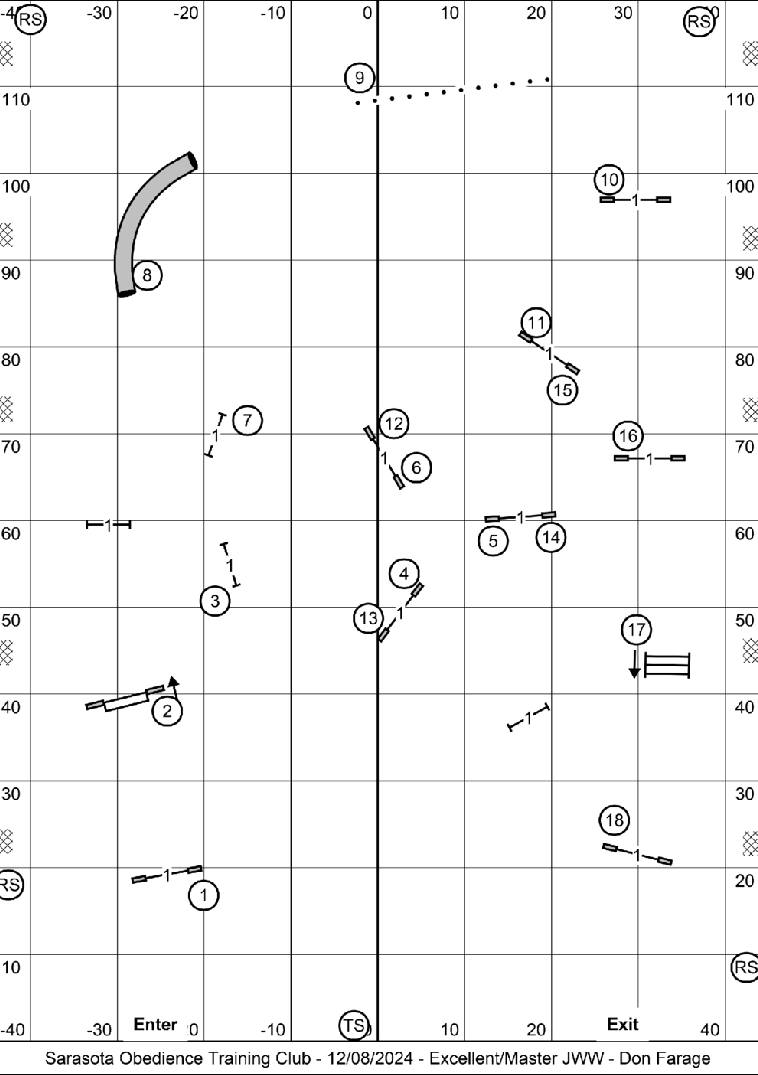
This weekend, I set up two Jumper courses to test Frankie's directionals. The first one was relatively straightforward. RIGHT RIGHT out of the weaves worked very well to turn her to jump 3. She has such wonderful distance that I was able to send her to jumps 5 through 8 while I stayed in the middle of the course. I called her to me over 8 then told her RIGHT RIGHT again to turn her over 9. This is a rear cross on the flat. To turn her over 13 and keep her off that off course jump 5, I told her RIGHT RIGHT TUNNEL. Then one more rear cross on the flat with RIGHT RIGHT to turn her over 17 to the last jump at 18. She had several clean runs on this course. Archie did too although I handled him in a more traditional way.


Today, I set up this more challenging Jumpers course. Yeah, that crowded bit in the middle was really tricky. Frankie only had a single clean run, our last run of the morning after almost hours of practice. But what a clean run it was! My verbal timing was good, she listened and responded and kept all the bars up, and even had a beautiful GO ON at the end to finish the last two jumps way ahead of me. 

As you can see from the labels, both of these are Excellent/Masters level courses. 


We may not be in Novice Jumpers for too much longer!

Wednesday, August 14, 2024

Go, Speedracer! Go!

 Frankie had a pretty good weekend at our last trial. She got her first FAST Q and earned her Novice Standard title. She also had five out of six very good start line stays. She's holding her position until I release her, and looking forward at the obstacle, not at me.

Her failed start line on the sixth attempt was entirely my fault. 

AKC requires dogs to enter and exit the ring on lead. Archie wears a very loose martingale on a nylon leash. It is mostly decorative as he doesn't need it for restraint when we enter. Even when I slip the collar over his head and toss the leash to the leash runner, I know Archie will stick by my side until I put him in position, and he will stay there until I release him. He's a good boy that wants to please me. 

Frankie wears a martingale attached to a braided fleece tugging leash on top of the buckle collar she wears all the time. She does need that leash for restraint. I guess I got overconfident. We entered the ring for her first run in Open Standard (I of course moved her up after she earned her Novice title). She was over-aroused, as usual, and I was a bit tired and distracted. The first obstacle was the tire, with a straight approach to the dogwalk, which she could see through the tire. I slipped the collar off her head and started to stuff the leash into my pocket. My mistake was not holding on to her when I did this. I thought she'd stay by me, like my good boy Archie. Nope.

She took off, slamming into the tire and heading up the dogwalk. Hitting the tire like that was a fatal error, equivalent to knocking a bar from a jump. So the run was already lost. AKC has a new feature called Fix-N-Go in which you can go back and fix an error. You still lose the Q, and you can't go back to the beginning if the error occurred in the middle of the course, and you can't attempt the fix anything more than once. But we hadn't even started the run, so my Fix-N-Go could start at the tire.

I called her back to me. She came right back! I made her sit and led out only a few feet away from her to the tire. I knew I couldn't get any more distance than that. She was so excited that she was nearly levitating out of her skin. I released her and off we went. 

And she had a really great run! She didn't make the Aframe contact, and she missed a jump near the end of the course, but that didn't matter because we weren't running for the Q anyway. Her performance was better than I expected. She smoked the weaves! People were applauding!

The effort and time I put into her start lines did pay off. I saw a lot more control and focus from her throughout the weekend. She's right on the cusp of understanding that agility is a team sport. 

Our next training goal: running contacts. Even though I have taught and used stopped contacts with every other fox terrier I have done agility with, I don't think I can realistically and reliably get stopped contacts from Frankie in a competition setting. Rather than fight her, I want to use her natural talents to make our teamwork smoother. Top competitors train running contacts to shave precious hundredths and thousandths of seconds off their time. That's not my goal. We are not world team material, and she's plenty fast to earn top placements in her classes once we work out the teamwork thing. I think that running contacts will feel more natural to her, and that will improve our communication on the course.


Monday, June 24, 2024

Oh, Frankie!

 So I'm trying to run Frankie at trials now. She's quite the handful. She is blazing fast, heedless of personal safety, and has some strong opinions about what she is supposed to do out there.

At our most recent, rather disastrous, attempt at trialing, a friend asked me, how's her start line? And I had to admit that it wasn't great. He replied, if you start a run with chaos, then the entire run will be chaos. 

I've been thinking about this every day for the past three weeks. It's a great example of how advanced handlers can readily see problems and solutions for other handlers and dogs but get a bit blind when it comes to our own situation. His comment spurred me to dig deeper into Frankie's training, and to go back and retrain a lot of her behaviors. 

She is unlike any other fox terrier I've worked with. She is astonishingly smart and relatively easy to train since she is both toy- and food-motivated, which gives me lots of options for rewards, but I'm having to learn how to work with unexpected minutiae of behavior that I never saw in my other dogs. 

Frankie has also made me rethink how I train, literally the mechanics of how I approach teaching, rewarding, and reinforcing behaviors. The most important change is that I can't fix problems in the moment. With Frankie, I need to keep going forward no matter what. If I stop, regroup and redirect her to fix something, like ask her to repeat a contact, she blows up. She becomes so over-aroused and so anxious that she can no longer perform at all. I can only note the problem so I can isolate it later in a separate training session. 

The second most important change is that I need to keep her training sessions very short. The longer she works, the more overstimulated she becomes, and our connection becomes very fragile. 

There are many, many dogs whose stress and anxiety produces the opposite: when they shut down, they disconnect, walk away, stop performing, sniff, leave the ring, etc. When Frankie tips into over-arousal, she doesn't want to leave but she's not able to actually do anything. She has big emotions and big energy but doesn't know what to do with them. It's my job to monitor her and manage her training so that we finish before she reaches that state. It doesn't take long, sometimes just 10 or 20 seconds.

And the third thing I've learned is that I need to stop micromanaging her and put the responsibility of self control onto her. There is no physical reason she can't easily clear the jumps, no physical reason she can't hold a start line stay, no physical reason she can't stop on the contacts. It's all mental control. I have gone back to the very basics of these behaviors and am retraining them with criteria that are more clear to both of us. 

Our journey is a bit rocky now but I know that I will be a much better trainer and handler with her as my partner.


Friday, March 15, 2024

Frankie: A Work in Progress

 Training Frankie in agility is a challenge. Well, it's a challenge no matter what dog you have, but Frankie poses some unusually challenging challenges. She's very fast, and outpaces me quickly. I started her on distance training early. I spent last summer working on a beginning distance class using Frankie and three agility friends and their dogs as test subjects. She hates to be drilled, and more than a couple of repetitions of a skill will frustrate her. She is heedless of personal safety and has taken out jump wings more than once. She drops bars, but I think that I'm the biggest problem there with late commands and getting in her way. She's a little dog but she needs a lot of room!

Because she is so resistant to drilling, I try not to spend too much time correcting mistakes. It works better for Frankie if I keep moving and circle back to the place where she had a mistake. I'd rather keep the speed and enthusiasm and focus on teamwork. 

Her start line stay was initially nonexistent. She'd stand up and walk or creep up to the obstacle, and she would break her stay if I took too long to get into position, moved, or even just took a breath. That's getting better in part because I have been working this behavior into our daily routine. But honestly, as Frankie gets older, she is showing a better understanding of her job. 

Frankie and I took two sessions of Rally Novice taught by another instructor at the club. Rally allows the handler to verbally praise their dog and use a lot more hand and body motion (with some limits) than formal obedience. Dogs and handlers navigate courses with stations. At each station, a sign indicates some sort of skill, like "dog down, handler walks around" or "270 turn to the left" or "about turn." Dogs are on lead for the Novice level. And it's like formal obedience in that the dog is worked from the handler's left.

 Frankie came into her first Rally class with no loose lead (that means she pulls on lead), no heeling (she forges ahead of me and often turns into my path), and no down. She's still not really got those things even now after two 8-week sessions, but she's getting better. And she has her moments of brilliance. Her left turns (dog on the inside of the turn) are just lovely. Seeing her excited to work with me for the full hour of class, and putting all of her energy and focus into this very non-agility activity, is a lot of fun.

Like most smooth fox terriers, Frankie went through a final growth spurt at about 18 months old. She got very lean and muscled almost overnight. She also got a little taller. She's lean, fast, agile, far too smart for her own good, opinionated...in short, the perfect smooth fox terrier.

Despite having significant reservations about whether Frankie was ready and concerns about her leaving the ring, I entered her in a trial a couple of weekends ago. One run, one day. This particular class could be run as FEO, for exhibition only. I could take a toy into the ring with me. I have 60 seconds to do what I want--run part of the course, all of the course, one obstacle over and over, you get the idea. FEO runs don't count for anything. It's an opportunity to train in the ring. Everyone kept asking me what I was going to do with her. I said, well, that depends on what happens at the start line. If she holds her start line stay, I will run the course. 

 First things first, however. Frankie got measured for the first time. At home, I had measured her as 15 1/2 inches at the shoulder. But now she had to be measured by a judge with a wicket. She did great! And measured out exactly at 15 1/2 inches. This puts her in the 16 inch jump height class as I had expected.

So how did Frankie do at her agility debut? She was magnificent. She exceeded all expectations. Her start line stay was amazing, never took her eyes off me despite the commotion in the gate area just feet behind her. She was a little worried about the new teeter but got right back on and performed it perfectly twice! Her weaves were blazing fast. Not one knocked bar. I could not be more pleased with her performance.

Video? Why of course, I have video. It's still on my iPad. It's enormous. I'll figure out how to get it dumbed down enough to slap up on the blog. 

In the meantime, I've got some agility training to do.

Monday, November 27, 2023

Frankie

It's time to lay out some of Frankie's origin myth. 

Oh, who's Frankie, you ask? She is the smooth fox terrier puppy I picked up over the Fourth of July weekend in 2022. She was only 10 weeks old at the time, and the last of her litter. I had some reservations about both of those facts but decided to load up Archie and Azza and drive out to northwestern Arkansas to see her. Her breeder was registered with AKC, and told me this was her last litter of smooths. She and her husband were switching over to whippets. I met the sire and dam and both seemed in good health and good conformation. The sire was a finished champion. 

And there was the puppy, a scrap of a thing, by herself in an expen under the shade of a tree. She willingly tugged with a raccoon tail toy I brought with me and seemed quite feisty and healthy. She had a lazy left eye and the usual "carousel horse" planes to her head that you see in American-bred smooth fox terrier lines. 

I had really wanted another male puppy. Male smooth fox terriers tend to be more biddable and willing to please. The females tend to challenge everything, making them harder to train. Archie is a dream of a companion and agility partner, and I was sort of hoping that I could strike gold again with another male. 

But nope, that wasn't happening. This little pup was coming home with us: last of the litter, runt, lazy eye, female. So many things that weren't on my list. But she had a spark that drew me in right away.

I named her Frankie. 


She's still a tiny thing, 16 lb and about 15" at the shoulder. Her lazy eye mostly resolved on its own. It will show up now and then but casual observers would never notice it.

In the past year and a half, Frankie has proven herself over and over to be one of the most challenging fox terriers I've ever worked with. At every waking moment, she vibrates, levitates, with energy. She never stops moving. She wants to be touching me all the time. She is exceptionally bold and oblivious to personal safety. As a result, she and Archie have never been in the same space together, although they do interact across gates in doorways.  

Azza fell into the role of auntie after a couple of weeks of cautious observation. Azza didn't embrace Frankie as quickly as she did Archie, but she eventually came around. Amazingly, Frankie can regularly inspire a lot of play in my 12-year-old desert dog. 


Frankie is a foreign body surgery looking for a holiday weekend. She eats toys, bedding, sticks, acorns, small stones. She chewed the handle and snap off a 6-foot nylon leash and swallowed almost 3 feet of it. Following a panicked call to a vet school classmate, I dosed her twice with hydrogen peroxide. Once she began to gag, I reached in and pulled out the leash.


Once I realized that I could not monitor her every move outside nor could I train her to stop constantly hoovering up inappropriate things, I ordered a customized basket muzzle that she wears when she is running around the backyard. I had to add some additional strips of duct tape across the bottom because within days she learned she could slam the muzzle down on acorns and pop them into the muzzle so she could eat them. This morning, she still managed to pick up a tree branch (not a twig, a 2-foot long branch) that had fallen overnight by pushing a smaller branchlet sticking off of it into the muzzle.

When I had her spayed earlier this year, she destroyed two cones and the collars holding them, and started to dehisce her abdominal incision within hours of coming home from the clinic. I ended up getting two full-body vests, rotating them every 24 hours so I could wash one, and zoinking her to the moon with alternating trazadone and gabapentin every 4 hours (plus a short course of antibiotics). I had to take three days off work because I couldn't take my eyes off her for a second. 

Frankie is currently taking a novice rally obedience class at the dog training club. One of the other students in the class complimented Frankie on her nice conformation, then gently asked, so, do other smooth fox terriers have a ... similar temperament? I laughed and said, no, Frankie is definitely a unique chaos agent all her own. She is so spicy, so much MORE than I've seen in this breed before.

On the bright side, Frankie sleeps very soundly at night in a crate next to the bed. Goes in without a peep, sleeps a full 8 hours. I'm not surprised--she has to recharge her batteries for another day of mayhem. 

Her agility training has been quite a ride as well. She is comically fast. Think Roadrunner cartoon fast. It has been a challenge for me to learn how to handle her. She gets overstimulated/frustrated very quickly, spinning in circles and jumping up to bite my arm. I'm fortunate to have good training partners and instructors who help us work through these problems. 

Everyone keeps asking me when I will take her into the ring, and I say, she's not ready. Not even close. Archie started competing at 15 months. You could argue that he wasn't quite ready then, but he wasn't hell on wheels either. Frankie and I are still working on performing as a team. But progress is there--in the past 4-5 weeks, she went from only being able to complete 4-5 obstacles before melting down to completing 12-14 obstacles with some semblance of control and direction. I plan to debut her this coming summer when she is 2 years old. She needs a little more tempering.


Thursday, August 31, 2023

MACH Rose Country's Bust A Move

In March of this year, Archie completed requirements for a coveted AKC agility title: MACH or Master Agility Champion. Once the dog reaches the Masters level of competition, he begins to accumulate MACH points and double Qs. Points are earned by clean runs under the allotted course time. A double Q means qualifying (running clean) in Standard and Jumpers With Weaves in the same day. At the Masters level, no errors are allowed. Dogs have to get 750 points and 20 double Qs to earn the MACH.


Archie is a reasonably speedy dog with no problems making course time. He had well over 1200 points and 19 double Qs by March. I entered the trial in Tulsa specifically because I thought we could run clean under those two judges. I'd shown to both of them many times and knew their course design styles well. 

He qualified in Standard in the morning. A few hours later, we entered the Jumpers ring. I'd been here plenty of times--one Q on the board then we fail to get that second Q. 

Tulsa isn't my home turf but there were quite a few people at the trial that I knew well or counted as agility friends. The arena was well lit, the dirt surface was firm. I wasn't talking about the MACH thing with anyone, but they were certainly talking amongst themselves. Knowing I had that Standard Q, quite the crowd was gathered at the Jumpers ring exit when it came time for us to run. They were filming me too, but wisely knew not to tell me that. I was stressed when I stepped into the ring. So many things could go wrong.

As Archie cleared that last bar following a lovely clean run, I ran over and picked him up for a big hug. We did it!

Archie is the first smooth fox terrier that I was able to put a MACH on. I've been at this with multiple dogs for 20 years. He is also only the seventeenth smooth fox terrier to get a first MACH since 2003. Yep, those are all correct numbers. This should tell you two things: there aren't many smooth fox terriers that do agility, and it's damn hard to be successful in agility with a smooth fox terrier. 

Here's a picture I took of Archie in the hotel that evening. My little athlete, taking a well earned nap.


One consequence of this achievement is that I immediately dropped Archie into Preferred. This means he no longer has to jump 16". Preferred puts him into the 12" class with the little dogs. He flies over those jumps!

Friday, December 23, 2022

Poop

I was at a dog show the other weekend, an agility trial. I was standing near my setup (the accumulation of crates, bedding, training gear, treats, snacks, and dogs that one hauls to an agility trial) thinking about what task I needed to tackle next. Because at an agility trial, there's always something that needs doing: taking a dog to potty, walking a course, checking the running order, volunteering, even just sitting down for a few minutes. 

I saw a woman come out of the bathroom, smoothing out a handful of poop bags clutched in one hand. I happened to make eye contact with another woman nearby, our eyes widening at the same time. She said to the first woman, is everything okay? The first woman was a bit confused and replied, yes? then realized she was clutching a bunch of poop bags, and started laughing. 

I said, yep, that's some hardcore bathrooming right there. We all cracked up. In her defense, the first woman explained that she kept her poop bags tucked into the waistband of her leggings (because no pockets), and had to keep track of them somehow when she went to the bathroom. 

Pottying, and poop specifically, is a big deal when you travel with dogs. Everyone needs to pick up their dog's poop to keep common areas clean. And if you are caught by surprise with a pooping dog and no poop bag (because you used it when your other dog pooped), all you have to do is call out to someone nearby, and they will readily give you one from their stash, whether it is a pocket or waistband!

 Per AKC rules, we aren't supposed to enter the agility ring with anything in our pockets, but 99% of us will have a poop bag or two tucked away. They are as much a part of our clothing as our socks. We don't think of them as "extra."

Poop is a regular and accepted topic of conversation between people who do sports with their dogs. We don't generally talk about our own poop, but hey, it's really all the same thing in the end.

Friday, November 26, 2021

Archie Update: Going to the Invitational

Archie and I have been working on our agility teamwork and handling these past few months. He is on his way to a MACH--he has 14 of the 20 double Qs required, and more than enough points. We stalled out this summer because I was pushing him too hard. I took a long break from trialing and spent the past couple of months focusing on training.

I'm not sure we will get that MACH. It will be a big accomplishment if we do. There are not many smooth fox terriers with that agility title. 

Our next big adventure is coming up in just a couple of weeks. We are off to Orlando for the AKC Agility Invitational. Going to the Invitational was definitely on my bucket list for Archie. After he advanced to the number 2 position in his breed this summer, I decided this was the year to go. Three years ago he was in the number 11 spot, and last year he was number 5. I didn't go last year but now that I'm vaccinated to the eyeballs and he's moved up so quickly in the rankings, I decided this was the year. He may qualify again in future years but I will only take him once. It's an expensive dog show and it eats up a lot of my paid leave. 

I went to the Invitational with Iz back in 2006. It was in San Diego that year. Boy, things have changed a lot in the past 15 years! For starters, there will be a lot more dogs there. As a result, there are many more rules and organizational fiddly bits that I have to keep track of. It was a big dog show back in 2006, and it's even bigger now in 2021. 

The Invitational is an interesting event. Only the top 5 dogs in each AKC recognized breed who are actively competing in AKC agility are invited. If any of those dogs decline, AKC moves down the list. To qualify for the AKC Agility Nationals, you have to be the best in your height class. Archie jumps 16" so he competes against small border collies and other fast dog breeds. Still, he's quite good and he qualified for Nationals this year (I didn't go). To qualify for the Invitational, you have to be the best in your breed. So "best" is somewhat relative. If there are only three of your breed doing AKC agility, you can be quite shitty at agility and still get an invite to the Invitational. 

As a result, the Invitational can be a mixed bag. You will see Basset Hounds, Elk Hounds, teacup Chihuahuas, Saint Bernards, and all manner of tiny mop dogs who somehow, somehow, still manage to knock down bars that are only 4 inches from the ground. You will see living examples of dogs that you've only seen before in books. And I can assure you, some of these dogs, both breed and individual, should not be doing agility in any form. But they will be there. 

One of the benefits of attending such a ginormous dog show is the vendoring. It should be magnificent! I've got some specialty items on my shopping list already. Bulk bags of freeze-dried lamb lung? Check. Real fur tugs in a thousand different permutations? Check. German steel thinning shears? Check. Hand-made leather collars? Check.

I have an "agility trial packing list" that I print out about a week before each trial we attend. I meticulously cross off each item when it is completed and/or packed into the van. Trim toenails. Take out the trash. Dog bedding for trial crates, car crates, and hotel. Bathe and groom the dog. 

The last bit may seem odd, but Archie stands out. He's got striking markings, and he's an unusual breed. Archie gets noticed. It would not reflect well on me (or his breeder) if I showed up to a trial with a scruffy, dirty terrier. As a result, he gets a bath 4 days before any trial, and is thoroughly groomed from nose to asshole 2 days before any trial. That schedule will have to be adjusted this time since we will be on the road for two days just to get to Orlando.

Lots of planning and packing. Always more training to be done. It's going to be an adventure.


Thursday, January 14, 2021

Sniffing The Pole

 In AKC agility, there are several different kinds of faults. An off-course fault is somewhat obvious--the dog takes the wrong obstacle, or jumps a jump then jumps back over it. Elimination faults are more or less a failure to complete an obstacle--the dog knocks the bar off a jump, or fails to put a paw in the contact zone on one of the contact obstacles. AKC still uses the pause table in standard courses, so there are table faults too--the dog fails to stick the landing and slides off the table, or jumps on then jumps off before the 5-second count has finished.

Refusals are the most complicated fault type. There is a zone in which a refusal can be called for any obstacle that is based on distance between two obstacles, how close the dog is to the upcoming obstacle, and "refusal planes" defined by the edges of the obstacle and the angle of the dog's approach. Complicated. But some examples might help. A dog that runs up to a jump then stops will get a refusal fault. A dog that runs towards an obstacle but spins in circles instead of approaching the obstacle in a determined manner will get a refusal fault. A dog that runs around an obstacle will get a refusal. If that dog takes another obstacle before the handler can correct the refusal, the dog also gets an elimination fault. The faults can stack up fast! But a dog that runs up the Aframe, stops at the top to gaze around the arena, then continues down the other side will not get a refusal.

At the Masters level, where Archie competes, you can only qualify if you run clean, with no errors or faults. One error, no matter which type, means no Q, even if you finish the course.

At an agility trial this past weekend, I encountered a situation that I had never seen nor even heard about. Archie's run so far had been clean. We approached the weaves and in he went. His weaves are extremely solid, and he usually executes them quickly. Archie rarely makes errors in the weaves. Except that day, that day as he reached pole 8, he came to a screeching halt. Dust puffed up around his feet. He was stock still, every muscle engaged, sniffing the pole.

SNIFFING THE POLE.

I of course keep eye contact with Archie on the course so when he stopped, I screeched to a halt too. I stared at him, then started pleading, whining, c'mon, Arch, WEEEEEEEEAVE, WEEEEAVE! Arch! WEEEEEEAVE! Over and over. I tried to keep calm but I was starting to panic. ARCHIE! WEEAAVE! At the same time, my brain was endlessly looping, What is happening? What is happening! I was looking directly at Archie but the far peripheral vision of one eye was on the judge, trying to see if he raised his hand to call a refusal.

Archie just stood there, sniffing. He never moved his feet. It seemed like an eternity but it really was only about 8 or 9 seconds (actually, that is an eternity in agility). Finally he decided he had sniffed enough and finished the weaves without error. Somehow I managed to keep my plan together and we finished the course.

I ran out of the ring with Archie in my arms and people said, wow, that was incredible! I gasped, did the judge call a refusal? They said, no, he didn't!

A spirited debate ensued. Was that a refusal? Was that a failure to execute? He never left the weaves. He did all the poles correctly. We decided that although it was certainly unusual, Archie didn't incur any fault. The run was clean. Another Q.

I am so grateful for my crazy fox terrier. He never fails to amaze and amuse.

Monday, January 11, 2021

A Tired Dog Is A Good Dog

Earning all of these:


...resulted in this: 


The OKC-area trials tend to have a small but rather competitive 16" class. To qualify is great (yay Archie!) but to get a Q and a placement is a big deal for us. He worked hard for me all weekend, and I'm proud of those ribbons.

Tuesday, August 20, 2019

Archie, The Delicate Flower


For weeks, the outside temperature has been only a couple of degrees cooler than the surface temperature of the Sun. Nonetheless, Archie is convinced that he is not able to get even a moment of proper sleep at night unless his entire body is in contact with mine and he is covered with a blanket. As soon as Archie is ready to sleep (there's always play time first!), he will begin pawing at my arm, which means he wants me to lift up the edge of a blanket so he can slide under it, preferably right next to me. A complicated dance ensues as I try to cover him without having the blanket cover any part of me. Why would I need a blanket? I’ve got a 12-kg, fur- and blanket-covered heat factory attached to me all night long. 

I'm quite excited that Archie starts agility class this week. The local club holds its agility classes outside, so I hope that it cools off as predicted in the next couple of days. I am not sure my delicate flower from the PNW is ready for the heat and humidity. I bought him a cooling vest, and plan to have plenty of cold water and a fan for him. For us both!

I introduced Archie and myself to the club via email. They asked me to do a brief skills test with Archie and one of their instructors. I thought that was reasonable and readily agreed. The instructor had come up with a rather difficult Jumpers-style course that was 17 obstacles in length but that only used 9 obstacles so most were repeated in various tricky ways. Archie of course crushed it. She then said, what about his contacts? I ran him up and down the Aframe a couple of times. He nailed that too. Weaves?, she asked. To show off a bit, I rear-crossed him as he flew through a set of 12 poles. No surprise, then--we are in the Advanced Class. It will be interesting to see how this goes for us.

I'd like to find a private instructor but that is going to take more time. We are going to need to start going to trials, get known by the AKC agility community out here, let word get out that I'm looking for that.

Monday, October 09, 2017

Archie On Fire--UPDATED

No, Archie is not literally on fire. But he has been burning it up in the agility ring lately. We had a bit of a break with no trials and no classes from late August to early September, and I think that was good for both of us, but we are back in the swing of things. Sadly, my surgery schedule this term prevented me from continuing with his Monday night class. He's been going to that class since he was 8 or 9 months old. I had to switch to a new night, new time, and new instructor. There are risks and benefits to moving to new classes and new instructors. Group dynamics are important, especially in small classes. And his original agility instructor definitely figured out the best way to handle me. I hope that I can communicate with the new one as well. I won't find out for another couple of weeks. But we continue with our Thursday night class which provides us with plenty of international handling challenges.

Vet school is becoming rather intense. I continue to go to trials but I only go one day, usually Saturday (most trials in this part of the world are three days long). One day seems to suit Archie just fine. He earned his Excellent Jumpers title this past Saturday, and can now start accumulating precious MACH points. He turned 2 years old on Sept 21, so that's a nice accomplishment for a young dog. 

UPDATE: I left the trial before placements were posted and wrote this before I received the confirmation email with the results. Not only did Archie earn that Q and his Excellent Jumpers title, he placed first in the 16" class. I kind of regret not sticking around and picking up that spiffy blue first-place ribbon. Go, Archie, go!

He has yet to earn an Excellent Standard leg but that's not for lack of effort on either my part or his. While he can struggle with contacts at trials because he is so damned high, an entirely unexpected problem has cropped up: the table. He doesn't want to get on the table at a trial. He performs the table perfectly, at speed, in class and at home. At a trial, meh, he says, I'd rather not. 

It is very possible that he just doesn't want to stop. That table represents a weird point of inactivity in a Standard run--the dogs have to jump on it and remain on it for the judge's count of five seconds (they can sit, down, or stand). One reason Archie has been doing so well in Jumpers is that he gets to run fast, run furious. He likes that! He was the fifth-fastest dog in his qualifying run in Jumpers on Saturday. That's quite competitive for a dog as young and green as he is. He still turns a bit wide and drifts here and there, and I know his speed will only improve as my handling and his path tighten up. He does have stopped contacts but I release him fairly quickly from those. The table is another challenge entirely for a dog like Archie. 

Archie doing a very nice teeter. Photo by Joe Camp, July 2017.

It's also possible that I am doing something different at trials when I approach the table. So I plan to ask someone to film us at the next trial. I haven't had a video of him in a while anyway.  

For the trial this past weekend, the hosting club decided to rent out some space in the large arena where the agility trial was held for a barn hunt test. Barn hunt tests and titles are managed by a separate organization, not AKC. Bales of hay are piled artfully in small, fenced-off bays, with a rat in a cage sequestered somewhere within. Dogs, mostly terrier types, have to find the rat within a specified period of time. It's kind of like earthdog but above ground. When I found out that the barn hunt ring was immediately adjacent to one of the agility rings, I was Not Happy. I began a mental draft of the stern email that I planned to send to the hosting club. I walked the boundary fencing line between the rings, marking all the places that a determined fox terrier could leave the agility ring and get into trouble on the other side. The other side where there were unleashed dogs and rats in cages all day long. My god, the potential for chaos was nearly infinite.

I should have had more faith in my dog. I have built an absolute crazed obsession for agility into Archie. He chooses agility over other dogs, other people, other distractions. He never even eye-flicked to the barn hunt side of things. In the ring, he was all about the game. 

I am incredibly proud of my fox terrier, even if he thinks the table at the trials is made of lava.