Showing posts with label teaching. Show all posts

Friday, May 23, 2025

Train the Trainer

In early 2022, I began teaching a new class at the club. Handlers that were moving into the agility track (Intro to Agility, Beginner Agility, etc.) from Beginner Obedience weren't working with their dogs as a team. The handlers had no idea how to train a dog. Sure, they could drag a dog in a circle around a ring indoors on lead and maybe they stuffed a few treats in its mouth now and then but they weren't really communicating with their dogs. I thought, here's a knowledge gap that I think I can fill.

When I first proposed the class, to be held on Sunday mornings inside the club, the reaction of the old guard was so extreme that you would have thought I had proposed slaughtering puppies on their own front lawns. The inside of the club was sacrosanct, to be reserved for clean obedience training (of course, based on punishment), not dirty training with treats! The club had never offered classes on the weekends! Training with clickers would disturb other people who needed to train indoors! The wailing, the gnashing of teeth, and the rending of garments was extreme. 

So I spent several weeks going to the club on Sunday mornings and documenting exactly who was using it and what they were doing. It was empty, week after week.

I resubmitted my proposal and was grudgingly granted permission to teach this new class for one session, with said permission given provisionally, ready to be yanked back if there were "problems." The Four Horsemen of the Apocalypse didn't make an appearance during those 8 weeks, so I kept going. 

I just finished the thirteenth 8-week session of my class. I guess weekend classes weren't such a bad idea after all because there are now Puppy Kindergarten, Beginner Obedience, and Scent Work classes offered on Saturday and Sunday in addition to mine. 

The class is called Teamwork. It's all about teaching handlers how to communicate with their dogs consistently and reliably. I use positive training methods and actively discourage negative markers and punishment. I teach handlers about rate and placement of rewards, how to use a clicker, and how to train behaviors with luring, targets, and shaping. Most of the exercises are flatwork, done with no equipment. As their skills progress, I add exercises with cones, platforms, and perch bowls. After 8 weeks, if they are paying attention and working at home between classes, the handlers and their dogs can execute all sorts of things that they will actually use in agility, obedience, and rally. 

What's so interesting about the class is that all of the training is for the handlers--but they don't know that at first. I mean, some dogs are a bit rambunctious and excited but what I am asking the dogs to do is pretty simple. Most dogs pick up the exercises right away. 

The origin of the idea for this class goes all the way back to the teaching I was doing in Saudi. I saw then that I could make a meaningful difference by helping pet owners communicate better with their dogs. It morphed to have more of an agility focus, of course, but the essential idea is the same. Owners that are reliable and predictable in how they communicate and reward their dogs will elicit reliable and predictable behaviors from their dogs.

The course content has evolved, of course. The addition that I am most proud of is what I now set up for the last class of each session: a series of exercises using hoops. Hoops are an agility obstacle used by the agility organization NADAC. Hoops don't require any jumping--the dog runs through them (see the picture below). I built four hoops to NADAC specs.
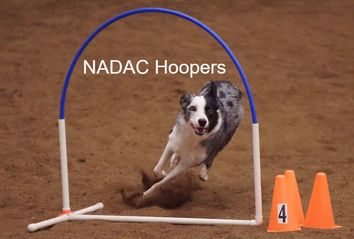
 

Agility equipment and accessories - Zippydogs Agility


I start the last class by letting handlers introduce their dogs to the hoops by navigating a simple circle through them. Each sequence gets more complex and requires more handling. By the end of the hour, handlers and their dogs navigate a 10-obstacle sequence with hoops and cones and side changes. 


This is a course map. Squares are 10 x 10 feet. The shaded dots are cones. The oval things are the hoops. Obstacles are performed as numbered. 


Most of the students taking Teamwork have never competed in organized dog sports. They've maybe heard of agility or rally and maybe want to take more classes. They usually come to me with no more training than a session of Beginner Obedience. But after 8 weeks of Teamwork, they are successfully completing a short obstacle course. 

I developed Teamwork to be a bridge from Basic Obedience into one of the performance sports. Is it working? Well, last night, the Intro to Agility instructor announced at the Board meeting that she wanted to make Teamwork a prerequisite for her class. She said that handlers who had taken Teamwork understand how to train a dog, and that it was night and day obvious who had taken my class and who hadn't. Teamwork students are more successful and advance more quickly in her class.

I couldn't be more pleased. It's validating to have an instructor I like and trust to explicitly say, Teamwork has a measurable, positive impact. Let's have more of it!

I love teaching agility, and many of my agility students become great training partners. But Teamwork is my passion project. I am lucky that I have the opportunity to share that passion.


Friday, March 14, 2025

Return of CircusK9

 Hi. I'm back. It's been a while. I didn't post too often when I was in school, because I didn't have the mental bandwidth to think or write about anything else. And the past three years? I've been settling into my new career. Lots of things have happened in my little world and in the bigger world outside in that time. 

I decided it was time to dust the blog off and put some more effort into it. CircusK9, by title and design, is supposed to be about my dogs. But I'm sure some interesting veterinary stories will creep in now and then.

Let's start the restart with some thoughts about teaching. For the past several years, I've been teaching classes at the local dog club. I gravitated to intermediate agility quickly, and have stayed put there. I don't like teaching rank beginners (I honestly don't have the patience for it, although that is what I did in Saudi with Mimi), and there is already a solid instructor who teaches advanced agility. 

Intermediate level handlers and dogs can see very quick growth in skills if they apply themselves. I get a lot of satisfaction from teaching them--who doesn't like to be successful? Some of my students have been with me for over 2 years and I have gradually pushed them to handling and training at an advanced level. Frankie is in my class and there are plenty of weeks when the material is too advanced for her right now. But it's the level of challenge that several of the other students need. 

I read books. I listen to podcasts. I sign up for online seminars and webinars. I subscribe to two (expensive) training programs (Bad Dog Agility and Agility Nation) so I can keep up with new training protocols and get ideas for classes. I even keep a Facebook account solely to get access to course maps. I put a lot of my own time and money into making sure I am delivering useful and current agility training information. 

I also teach a class that I created back in 2020 that I call Teamwork. I saw a big gap between the formal, old-school obedience classes that formed the bulk of the club's class offerings and introductory rally and agility classes. Handlers were coming into those dog sport tracks without any understanding of how to train a dog. Teamwork is all about training the handler and teaching them how to communicate consistently with their canine partner. The dogs come along for the ride, and they just love it. In contrast to the old-school obedience training offered at the club, I only use positive training methods and high rates of reward/reinforcement. No pinch collars. No electric shocks. No leash yanking. No verbal corrections. Sounds reasonable to you? I can assure you, Teamwork is still viewed as subversive and radical, even after five years. I also upset the old guard by insisting that I teach it on Sunday mornings inside the building. Wailing, gnashing of teeth, and rending of garments ensued. What if someone decided they needed to train at 10am on a Sunday? How could they possibly do that if I was teaching a class? Turns out all those folks who said Teamwork would cut into their training time don't actually come to the club on weekends. I collected the data to prove it. That space was viewed as sacred, only to be used to punish, er, train dogs for formal obedience competition. Here I was, jumping around, treats flying, clickers clicking, dogs and handlers happy as clams. Subversive indeed. 

I teach Teamwork 5 or 6 times a year in 8-week sessions. It is one of the most popular classes offered at the club. The class fills every session with club members and non-members both. I get rave instructor reviews.

I love teaching agility. I find it exciting and challenging. But I really love teaching Teamwork. Usually around week 4, the shift in the relationship between dogs and handlers becomes obvious. I love seeing that. 

Four of the old guard are taking Teamwork from me this coming session with their young dogs. I think they know, in their dark, cold hearts, that I am right, that positive training is the correct and ethical way to train. I've alerted my assistant instructor that we are in for a wild ride. I absolutely will call them out if they revert to their punishment-based training methods in my class. But I have to give them a tiny bit of credit for being willing to brave me and sign up for it.

 Teaching revives me. It is an important social activity as well as one that gives me emotional and intellectual satisfaction. I teach because I like to learn. I succeed when my students succeed. I guess that's why they keep signing up.


Thursday, May 09, 2013

Oh Dear

Tonight was the first meeting of Azza's obedience class. We had to show up without the dogs. I can certainly understand the value of the instructor giving the group some basic instructions without the distraction of the dogs, but almost two and a half hours of it? She nattered on about the most irrelevant and annoying nonsense and only got to the real meat of the entire affair AFTER we were supposed to have already finished (specifically, what we were supposed to prepare at home for next week's class).

Having taught such classes to dog owners who lack the faintest clue about dog training, I can tell you that rushing through the instructions for how to train the name game, collar touch game, and a sit-stand-down combo is a waste of everybody's time as she'll just have to repeat it all next week.

On top of that, not one of those green handlers got an opportunity to practice any of these new activities under a guiding eye. They didn't get to practice the timing of their marker word, they didn't get to practice the placement of the treat for luring a sit or get any advice on how to get their dog to sit by their side (many untrained dogs have problems with this since they are used to facing their owners for their treats).

The instructor showed no understanding of or respect for different learning modes (how people learn), spoke disparagingly of vets, and spoke continuously with hardly a pause for breath. For two and a half hours. The environment was not one that encouraged inquiry or exploration.

To add insult to injury, the instructor had two of her own dogs and the assistant instructor had one of her dogs running around unleashed. It seems that the assistant's dog is there "to be trained." They used these dogs to model the homework behaviors for a total of about two minutes (they didn't even offer to let one of the participants give it a try with the dogs). The rest of the time there was a lot of pointless showing off, solipsistic rambling, and a couple of times even some factually wrong statements.

When I was teaching the obedience classes in Dhahran, I fretted a bit about taking Mimi to class (I think I even wrote a blog post about this). I was worried that it seemed self serving. But I never used her to demonstrate a skill when I could use a class dog instead. I never taught her new behaviors during class. I never let her off lead.

I am not paying these clowns to train their own fucking dogs. I am not paying them to talk over questions from the handlers. I am not paying them to operate doggy day care during an obedience class.

I am not sure that I will return next week. I need to think how or even if I can make this a positive experience for Azza. It won't be a positive one for me.

Friday, December 07, 2012

Agility in KSA

The latest season of agility in KSA is winding down. We'll be taking a break from about Christmas to the beginning of February.

We added some new handlers for this set of classes and I'm very proud of the progress that everyone has made in the past 10 weeks.

With intermediate-level handlers to serve as models, I felt that I could push the new ones quite a bit and the intermediate handlers even harder. Most of them are doing respectable to impeccable front crosses and RFPs, can sort of read course maps, can handle serpentines and threadles, and can direct their dogs to the backside of jumps. Their start-line stays aren't quite where I'd like them to be but that is because none of them are practicing this at home despite my weekly exhortations/pleading/nagging (my actual tone doesn't seem to make any difference). Most of the handlers are doing two sets of somewhat closed 2x2 weaves. PM and her yellow lab Nellie are doing six poles (three sets of 2x2x) with nearly closed poles. I have been enforcing handler positions and dog entries and we've been using targets for most of the dogs for the weave exercises. If we can keep at it, I may have 3 of the dogs doing inline weaves by the end of the next session (February-March 2013).

We've done skills challenges, CleanRun Backyard Dogs courses, and courses of my own design. Sometimes they work flowing sequences of 7 to 10 obstacles and sometimes they work skills on 3 or 4 obstacles. I try to mix it up as much as I can with our tiny equipment set.

It's really interesting to me to figure out what each dog and handler pair needs in the way of coaching and guidance. Some of my readers who do agility would probably find that maddening. I find new insights into how people and dogs learn and how they "see" agility obstacles. Sometimes getting a handler to do her front cross in the right place at the right time is a huge success. Sometimes getting a dog over a jump with joy and intent is the success. Every action is measured anew for each team.

For both the basic obedience and the agility classes, I decided to increase the level of my communication with them outside of class. A couple of days after every class, I send an email to everyone recapping what we did in class, explaining things in detail as needed, and tell them what we will be working on for the upcoming class, and reminding them of the skills they should be practicing as homework. The emails are a lot of work as each one may take me 30-45 minutes to write and edit. It's a one-sided communication as I rarely get replies but I have had several handlers tell me that they appreciate the emails.

I haven't posted many photos because the larger class size doesn't give me that luxury. But I'll leave you with this:

Seven jumps, two tunnels, one chute, five pairs of tunnel bags, three sets of 2x2 bases, all the required poles, two gear bags (one with water, numbered cones, shade, and clips, and the other with treats, toys, clickers, targets, course maps, wallet, phone, and all of that kind of personal gear), six weave poles (hinged on a steel base and not actually in this load), a crate dolly, assorted bungees, Mimi's soft crate, and Mimi (in the front passenger seat) in one Honda CRV. Whew!

Friday, September 07, 2012

Puppy Class

Here's some really old news but I'm in the process of catching up on the blog so I thought that I would start here.

Back in April, after the regular obedience and agility classes had ended, I was pressured by some acquaintances to offer a puppy class. Because I was going out on leave in May and because a puppy class was something new for me, I decided to limit it to four weeks.

The puppy class was certainly an experiment. It isn’t something I can run on a regular basis since it will be uncommon to have a sufficient number of sufficiently young pups available at a given time here in Dhahran (I found out that the camp vet only has about 800 dogs registered, which is fewer than I expected). Still, I wanted to try my hand at working with younger dogs. Most of the dogs were around 16 weeks old, which is much older than you'd see in puppy classes in the U.S. But I have to work with the dogs that are here.

Azza and three golden littermates, two males and a female (the female is also on the ground next to Azza). I certainly wouldn't have chosen to have three littermates in the same class, but it worked out okay.

 I did a fair bit of research to figure out how best to structure the puppy classes. For example, I don’t allow the dogs in my basic obedience class to interact before, during, or after class (while they are on school grounds, at least). But this rule clearly had to be relaxed a bit in the case of young dogs that need to play with other dogs in order to learn proper play habits and signals, bite inhibition, and so forth. We started each class with a free "play time" in which the pups were allowed to be off leash so they could explore some of these signals.
 
I came up with at least four “what is that?” stations each week for the first three weeks of class. This stretched me a bit in terms of resources, but I managed to drag in plastic bags, a hair dryer, a cardboard box, plastic mesh that I taped to the floor, metal cookie sheets, orange cones, hats and abayas, an agility tunnel, a tippy board…you get the idea. For about 15 minutes of each class, I had the handlers take their dogs through/across the stations. It was a bit chaotic and noisy but that was also part of the exercise. I wanted to encourage all the puppies to explore and be rewarded for it. I also wanted the handlers to learn how to reward their puppies for all types of behaviors, not just the standard sit and come.

I included a short activity on grooming (cleaning ears, clipping nails, brushing coats) which turned out to be revelatory for one handler. She complained to me that her dog resisted all attempts at grooming. Turns out the woman was using a wire slicker brush! I'd resist that to if you tried to drag it through my hair! When I had her use a boar bristle brush on her dog, the pup stretched out on the ground, totally limp. She was so happy to learn this one new thing!

As I mentioned in a previous post, I also had the class play “pass the puppy." This is a great game to get the young dogs used to calmly interacting with other humans. Everyone sits in a circle and passes their puppy to the person to the right. After about 30 seconds of petting and treats, the dogs get passed to the next person, and so on until the pups end up back with their owner. It's another chaotic and noisy game but everyone really enjoyed it.

I brought Azza each week and even though she peed on the floor every time someone approached her to pet here or when she met a new dog, I think it was a reasonably good experience for her.

I have become much more comfortable working with kids and their dogs and now encourage parents to bring their kids as long as the kids are actually doing training, not sitting around doing nothing or even worse, being disruptive. I don't run a day care, right?

Because I only had four weeks, I decided to scale back the formal commands that I introduced to just the basics: hand touch, sit, stay, and come. But I am happy at how many activities I was able to include in just four one-hour sessions. I certainly kept those pups and handlers moving!

This has to be my favorite shot from the class. This is one heck of a dedicated owner. And yes, that chichi did go through the curved tunnel eventually! The chichi was a real hoot, a classic "giant dog trapped in tiny dog body" dog.

Thursday, March 08, 2012

Dog Obedience in Dhahran

I may never get used to my infamy amongst the expats in camp. When I am introduced to someone, they nearly always pause for a second then say "Oh! You're the 'Dog Lady'... or the 'Dog Teacher' or the 'Dog Whisperer' (which I totally hate) or my favorite, the 'Dog Guru'."

When you're running the only dog training show in town, word does get around.

Because I have a big trip planned for May on dates that fall right in the middle of the next session of Community Education classes, I'm not teaching the Basic Obedience class during April-June. All of the folks at the Community Ed office emailed me to say how much my class would be missed!

The current obedience class finishes up next week. While it is a tremendously fun experience to teach each eight-week course, I am always a bit relieved when I am done because I have my weekends back. And I am resolved to spend a bit more time out of camp than I usually do.

I have been reading and researching new ideas for the obedience class and am slowly incorporating many of them, to the betterment of the class. For example, for the weeks 6 and 7 classes, I hauled an agility tunnel and tunnel bags to class. This is actually almost as much work as hauling all of the gear to the agility class because the obedience class is held in a large, air-conditioned room that is up two flights of stairs!! Piling stuff on the crate dolly is not a solution--no handicap access ramps in Saudi Arabia. I have to carry all that stuff up to the room.

Since the primary pool of new agility participants will come from my obedience class, I figured, why not give them a tiny taste of agility (the tunnel is the obvious choice) and at the same time give myself a chance to evaluate them and their dogs with a critical eye?

All of the dogs loved the new experience, which means their handlers loved it too. I even had two handlers successfully send their dog to the tunnel this afternoon!

I also switched up the curriculum so that I introduce some behaviors earlier so that they get lots of reinforcement over the duration of the class. As a result, the dogs are doing extremely well with loose lead walking, one of the most common problems people have with their dogs.

The best part is when the handlers tell me how much better their dogs are behaving at home or on walks. As always, it makes me proud of the time and effort they are putting in to training their dog. And it makes me feel good that I helped them get there.

Friday, October 21, 2011

Agility in KSA Week 3

I've got 90 minutes of video from yesterday's class to wade through! Definitely some great footage of the dogs and handlers. But I've been feeling kind of crummy for several days--the weather changed and we've had strong winds from the northwest blowing sand and dust around so my sinuses are now officially on strike. On top of that I've been fighting an intestinal bug that's been going around. I have steamed snow peas and rice waiting for me; after I eat some, I'll probably head off to bed early. So you will have to be content with still photos again.

MH and I introduced the handlers to their first sequence, the classic jump-tunnel-jump. I even put up cones although they are hardly necessary for only three obstacles! Somehow the cones make it look a bit more like the real thing. I was really surprised at how hard it was to get the handlers to cross the plane of the second jump, that is, to continue forward and reward their dogs on the other side. The handlers kept stopping right before the second jump--and of course the dogs did too. But this is a First Ever for all of us, me for instructing and them for doing, so we are all learning new things. I'll explain the exercise differently next time.

After we had them do the basic sequence on both sides a few times each, we had them do it again with a front cross before the second jump. They are definitely getting smoother and faster with their footwork and timing. 

It's been quite a while since I had to train the basics and I'll admit that I need to back up a bit next week and work them on drills for sending to jumps and tunnels. But despite the steep learning curve we are all on, everyone seems to be having a great time. And I always have to keep that primary goal in mind!

I just want to thank all of you blog readers for sharing the news of our agility adventure with your friends. The page views of the first post are setting records for my blog (not that this is a high traffic site to begin with; it's all relative). But thanks for forwarding the link!

Kris and Kanga. They were absent last week so we had her work on a straight tunnel instead of a curved one. Notice that the bar is set low. The surface is rubberized but still a bit too stiff so all of the dogs jump very low bars.


PM and her crazy lab Nellie. Later in the class, Nellie got the zoomies, dived under the mesh we have clipped up on the openings of the area we are in (admittedly, the mesh really isn't intended to stop a determined dog, and it didn't), and continued her zoomies in the larger school grounds. There's always one in every class! Nellie was collected in good order however.


MW and her shepherd mix Boodle. MH is patiently holding his leash. Mr. B (as I have nicknamed him) is an anxious dog who is very cautious around new things...like scary plastic tunnels. He just doesn't want to put his feet in there. But this picture represents a huge success over the first week: Boodle actually put his head and shoulders in the tunnel. I've loaned MW my second tunnel so she can continue Mr. B's desensitization at home during the week.

This is Chris and his gorgeous standard poodle Beau. You can tell that they are both into this exercise!

J and her terrier mix Aris, who is 10 years old and has a bit of a bum hip. She was completely unprepared for his speed out of the tunnel, but adjusted quickly! J was a bit worried about her little old guy when I invited her to sign up for the class. She didn't think he would run. Well, he hops over the bars like a pup, reads her turns like a seasoned champ, and walks around during class like he owns the place.


Another picture of Chris and Beau. MH grinning in the background. I have to constantly remind my basic obedience folks to praise their dogs but the handlers in the agility class are much more proactive. Chris poked around on the internet, found a recipe, and made some fabulous little cheesy treat bites--brought baggies of them for everyone in the class! You can tell that Beau found them well worth working for.

I wanted MW to be able to practice the front cross footwork for this exercise and since Mr. B is not doing the tunnel yet, I loaned her Mimi. Here, MW isn't crossing the plane of the jump so Mimi correctly interpreted her body language to mean that she should wrap the jump. What a beautiful tight turn my little terrier can make!

Sunday, October 16, 2011

Inspiration

I know you are all checking the blog for an agility update (I can tell because the page count is up) but I am going to first put up a short post about teaching people and their dogs.

I think a lot about how to do that since it has become my major hobby here in KSA. This session I tweaked the lesson plan for my basic obedience course after nearly two years of success because I thought that the handlers would do a better job of the "final exam" (teaching their dogs a trick/behavior that I don't teach in class) if I introduced the concept of shaping sooner. I spend every obedience class circulating around to each dog and handler multiple times, giving them my undivided attention for at least a couple of minutes each visit. I check the gear in my little plastic crate every Wednesday evening to make sure I have all of the handouts, clean up supplies, toys, and other items I might need for the coming weekend. I buy and process turkey hot dogs and chicken breast and string cheese to make sure that the instructor always has the best treats. Before every new session, I distribute a questionnaire to each handler and I read them before every class for a couple of weeks until I know every dog's name and the particular issues or questions each owner has. I send an email update almost every week to review what they should be working on at home.

In short, I invest a lot of time and energy in preparing and delivering the basic obedience classes.

And now the ante has been upped considerably with the agility class. I pack all the gear in my car the night before. I have to get up at 3:30 a.m. to ensure that I get to the class site by 5:30 a.m. so that MH and I can unload my car, dolly all of the stuff to the site, set up equipment, and work our dogs before class starts. I bought DVDs and reread training books over the summer so that I had a variety of methods ready to hand to explain the same concepts in different ways. I design exercises to take into account the limitations (challenges?) that the dogs and handlers bring with them. I am barely a step ahead of these classes in terms of planning but knowing that I can be creative and flexible with my tiny set of gear helps.

And every time I step in front of a class of hopeful handlers with their excited dogs, I call to my mind the agility instructors who inspired me, who taught dog handling with humor and insight and kindness, who seemed to display infinite patience even when I, as a participant, wanted to throttle one of my fellow handlers. I think about how they organized their lessons, their gear, their own dogs. I think about how they encouraged me and others. I think about all of these things in those few seconds at the start of each class because I want to be that kind of trainer for my classes.

In particular, I want to single out Debbie Spence, owner of PAWS in north Texas. I spent a couple of years training with her when I was in Dallas (many of the posts in the first two years of this blog are about my training and trialing experiences as one of her students).  Of all of my agility trainers, she has become my role model. Debbie, I want you to give yourself a pat on the back for being such an inspiration that I could even conceive of the crazy idea of bringing agility to Saudi Arabia.

Saturday, October 16, 2010

DOG-101

We just completed the fourth week of DOG-101. It's going very well. There are 10 dogs in the class--and nobody has dropped out yet. Eight is the ideal class size for me to manage but I suppose I can't say I want anyone to drop out just to make it easier for me. They are all working very hard with their dogs. I managed to get photos of 7 of the dogs.
This is Peaches. She's a small poodle mix. Very sweet. She doesn't have any particular behavior issues other than the common small dog habit of jumping on people for attention. Her family just wanted to learn how to train her. I can usually pull her out for a class demo.


This is Yankee. He's very probably an Eskimo mix. Cute but rather nippy. Last week he showed some rather nasty aggression towards another dog so he does have some issues. His owner doesn't work quite as hard as I would like at the training but they are doing okay.


This is Moe, one of three labs in the class. Moe is a rehomed K9 unit dog so he's already pretty well behaved. Moe's big problem is that he doesn't know how to be a pet. He's a very friendly, calm dog. He seems to enjoy the training and class environment.

In the background of this pic is Charlie, the BC. Charlie has some major issues with the other three big dogs in class. He becomes frantic with barking at just the sight of them. After doing some research, I came up with a rather involved plan to try to nip this little habit in the bud. Charlie and his owner did have to spend most of the last class behind blanket-draped chairs. She was prepared to squirt him with water if he barked but we never heard a peep out of him. She also C/T when he was quiet and did some simple TTouch petting at the same time. She was totally amazed at the success!


This is Nellie, another lab. She is also a rehomed K9 unit dog. She's quite a bit more boisterous than Moe (that's probably why she flunked out of K9 unit school) but she's a typical goofy lab. She got a bee in her bonnet with all of Charlie's barking and stink-eyes and spent most of the third class trying to outbark him. Last week, we were prepared to squirt her with water too. But by keeping Charlie quiet and out of stink eye range, Nellie was quiet and focused on her handler for the entire class.


This is Macy. She's another poodle mix of some sort, a rescue from the Bahrain animal shelter. Her biggest problem is that she found just about everything on the planet more interesting than her family. I've been working on them a lot to "be more interesting than dirt" (and worms and dead pigeons and cat poop and....) and we are starting to see an improvement in her focus and attention on them.


This is Ido. She's a Saudi street dog, rescued by her family from some Philippino workers when she was a few months old. All feral Saudi dogs look a lot like this. She's probably a mixture of Saluki, Canaan, and god knows what else (GSD, lab, retriever, dobe...). For a variety of reasons (I can share my theories on this in another post), these dogs are paralyzed with anxiety and fear when they are outside their homes. Some of them act out with extreme aggression, attacking other animals and people. There are unfortunately too many of those dogs on camp. They aren't allowed in the DOG-101 class. Thankfully, a good number of them are like Ido. She has yet to take any food during class in four weeks. She wouldn't even come in the classroom the first week--her owner carried her in the room. The second week, Ido came in the room but slinked along the wall to face a corner. The third week, she came in the door under her own power and sniffed around my things a bit, then stood or sat the entire class next to her handler, ears down or back, tail tucked. That third week, I introduced the concept of using a mat as a "safe place" or "calm place". Her owner takes copious notes, does all of the exercises as home, and introduced Ido to the mat--with quite a bit of success! Last weekend, she came in, put down the mat, and Ido promptly sat on it. During one of the exercises (a recall exercise), her owner managed to get Ido off the mat, asked for a sit, Ido sat, then she told Ido to go back to her mat. Ido stretched out on her mat, front paws crossed, and calmly watched the rest of the class. Her tail was stretched out behind her and her ears were pretty much up as they should be. It's the most amazing thing to see these dogs come out of their shells. This is now the fourth dog of this type I've been able to work with. It is so satisfying to see these dogs become more calm each week and to see their owners be so proud of their accomplishments. Sure, sure, Ido still isn't taking food in class or doing the exercises. But we have to use a different metric for each dog--it's not a one-size-fits-all kind of thing, dog training. If Ido will do a sit in front of the entire class by week 8 and take a treat for it, I'll consider that a training success.

Wednesday, August 04, 2010

Latent Learning for Production Engineers

If you do much dog training, you appreciate the power of latent learning. Good trainers know that drilling a dog over and over on a skill in a single training session can have all sorts of negative consequences: the dog learns lots of different wrong ways to do the skill (learns by repetition, possibly even by poorly timed reinforcement), the dog gets bored, the dog starts getting worried about repeated failures and shuts down.

I've mentioned that Mimi is a training sponge. By this I mean that she will happily train without a break for 20 minutes, 30 minutes, even longer. But even if I do maintain a training session with her for so long (rarely, but it does happen), I still don't drill the same thing over and over. Once she has a successful performance of a new skill, I'll move on to something else right away. (It is so difficult to resist the lure of "just one more time" but with experience and practice I'm getting better at it.)

The latent learning comes in at the next training session--that evening, the next day, perhaps a few days later--when I ask her to perform that particular skill again. Well-timed reward of a successful performance plus a bit of time can solidify knowledge and understanding of the skill. The next time the dog attempts it, she'll perform it correctly right away or at least with fewer attempts to get it right.

I am currently teaching a class on petroleum geology to a group of young Saudi production engineers. I selected the content and designed the exercises and am now delivering it for the first time. Yesterday, I turned them loose on a big case study that requires them to integrate core and wireline log data to characterize a particular reservoir. This workflow is one that geologists in Aramco apply. The outcomes of the workflow are used by reservoir engineers so the goal is for them to better understand where the stuff they use comes from. The class, divided into teams, worked on the exercise for about 3 hours yesterday afternoon. Most were clearly struggling to make sense of the data and to get their heads around even the statement of the problem to be solved. However, I made sure to spend a lot of time providing positive support for their efforts and questions, even if they started out chasing the wrong things.

I told them to go home and "sleep on it."

Two-thirds of the class were at it early this morning even before class started. I've made three passes through the room and there have only been a handful of questions focused on clarifying individual points. It is clear that they are no longer wrestling with the larger issues of integration of the data and making sense of the geology. They may not have the right answer but each team appears to have a plan for their presentation.

What a difference 8 hours makes. Well-timed reinforcement and a bit of time gives us latent learning in action.

Thursday, May 06, 2010

Communicating

French class continues to move along at a reasonable pace. The attrition in this second level class has really surprised me. We went from 5 to 2 students from week 2 to week 3. It is like getting a private lesson from Madame Hela for an hour and a half twice a week. We still only know two verb tenses, present and past (passe compose), because of late she's been focused on having us speak French more. We are not allowed to ask questions in English anymore and when she introduces new vocabulary, Madame Hela tries to give the definition in French. That can certainly be confusing but since her English isn't all that great (as she herself admits, she isn't an English teacher!) it more or less evens out in the end. We also have to do a lot of readings. My pronunciation has really improved. Even my R's get the nod from Madame now. What I can't seem to get is French spoken at normal speeds when I can't see the speaker. Madame plays recordings and I get maybe one word in five. Actually, that's being too generous. One word in ten is more like it. And those words are usually the nouns. I can't "hear" the verbs when they are spoken. I've got some podcasts but have the same problem with them. Can't figure out a damned thing they are saying. If they talk really slow and I can replay it, I can figure it out. If I can read a script while listening to a recording, I can figure it out (still need to replay it a few times). But just straight listening? Not so much.

Ah well. I've been told that levels 3 and 4 of the French classes are taught by a different teacher and involve a lot more conversational exchanges. I suppose I should focus on grammar and vocabulary and let the rest come as it will.

All of this was put in a new light by a training class I attended last week for work. I am going to be teaching a geology flagship class to new Saudi geologist starting Saturday. They were selected back when they were in high school and sent to the US, UK, or Australia to get bachelor's degrees. Therefore they can speak English but it isn't their first language. During our training class to prepare us for teaching these courses, I was teamed up with a colleague, a Chinese guy, a petrophysicist, who will be teaching the petrophysics flagship. He and I thought it ironic that we had a weakness in common: language. His accent is extremely thick and you have to listen to him carefully to understand him. I speak American English at light speed and drop word endings and vowels liberally. When speaking formally I can avoid colloquialisms but I probably won't be able to keep that up for two weeks, the duration of the course.

Communication. Language. Being a teacher and being a student. These concepts have been occupying my thoughts the past few days.