Showing posts with label training. Show all posts

Friday, March 20, 2026

Spicy

I’ve been working through some training issues with Frankie in the past few months. If I am honest, these are things I should have been addressing when she was a puppy. I had no idea that she would turn out to be such a spicy little speed demon.

Her performance in the competition ring is quite different from what she does when we are training. The biggest problem, and there are several, is that she won’t come to me at the end of a run.

I’ve done pattern games. I’ve worked on building value for the leash. I’ve dropped leashes all over the training field and interrupted her runs to ask her to run to a leash for a reward. No problem! But in a trial, her brain leaks right out of her ears. I can usually (but not always) get a full run out of her but we rarely finish the course together.  After she clears the last obstacle, she takes off and runs around the ring, refusing all recalls and attempts to catch her. She’s even become wise to people holding out food. She doesn’t take any obstacles, just runs around at top speed. I’ve been complimented many times on how fast she is … while she is running around like a feral beast. Not her finest moments. 

My interpretation of this behavior is that she is so overstimulated that she simply can’t stop at the end of the course. She still has energy to burn.

So what’s the solution? Her drive is off the charts on a normal day. She can ramp up in seconds. I want to use that drive, not squash it. Since I don’t think I can bring her arousal down in any substantial way, I need to try to plane off the spikes. 

On recommendation from friends, I consulted with a local trainer who has a reputation for working with spicy dogs like Frankie. She said, “Look, you aren’t going to wear this dog out by throwing a ball at the trial.” I agreed. Besides, playing with balls and tugs ramps her up even more. Then she dropped this: “But wearing her out shouldn’t be your goal.”

What a revelation! Of course. I need to find ways to shape her drive and help her with impulse control. Trying to make her tired doesn’t address either of those things.

This trainer recommended sniff walks before every run. Those are 10- to 15-minute walks in which I ask nothing of the dog. Frankie sets the pace. If she wants to sniff one spot for 5 minutes, that’s fine. The only requirement is that she not pull on the leash. Sniffing releases endorphins. Walking and sniffing are gentle, steady stimulation, not rapid jerks and spikes like play brings.

I tried this at the last trial in February. It was a challenging task with morning temperatures in the teens, but I managed to pull it off four times each day. The time management was exhausting. But I did see a small difference even though it was the very first time I tried this. Frankie’s focus was better at the start of each run. But she was still running off at the end, especially on the second day. While sniff walks are an important addition to our trial routine, they won’t solve everything. There’s still some training to do!

Since early December, I’ve been training Frankie in contact heeling and its related movements. I will try to remember to film one of our training sessions, but you can check out videos of this online. It’s used to train dogs who do bite and protection work. It’s also used for reactive dogs.

 It’s not just about heeling but about positioning the dog in space. What sets it apart from old-school obedience training is that the dog remains in close physical contact with the handler. Plus, a lot of the contact heeling trainers use positive training methods, even for dogs training for bite work, and I’m all about that. No leash corrections or e-collars for us. Once I learned about contact heeling, I realized it was a missing piece for Frankie! I had already noticed that she likes to be touching me. I realized I could use this training to build more value for being with me, build routines that include movement (Frankie wants to go go go all the time), keep up a high rate of reward, and be able to take all of this on the road, that is, use it at trials, not just at home.

We are by no means experts, and I have no intention of training her up to competition level, but I am seeing a shift in her focus and attention. I’ve added contact heeling moves to our gate and start line routines for agility. Instead of trying to distract her with treats before we go in the ring, which only ramp her up, I ask her to calmly and smoothly move around with me in coordinated, set patterns that she knows and has been rewarded for many, many times.

Frankie will be a life-long project. But I am grateful to be learning so many new things with her.


Thursday, July 03, 2025

Summer Training Goals

 My training goals for Frankie this summer are to expand her repertoire of skills. I'm particularly focusing on skills that are needed to run the more international-style courses such as AKC Premier. For those courses, the dog needs to have many different collection and turning cues, far more than are needed to fumble one's way through a regular AKC course. 

AKC got rid of the pause table in Excellent/Master classes last year. This was a long-overdue decision. Nobody will miss it. However, the pause table was often used by judges in their course design to create a hairpin change in the dog's path. Rather than toss out their old course designs, many judges replaced the pause table with a wrap on a jump, in which the dog approaches a jump, collects, and turns very tightly around the wing, usually with a 180 degree change in direction. While wraps were used before the pause table was removed, we are seeing them in almost every Excellent/Master Standard course now. 

Frankie doesn't like to collect. It's a common problem with some dogs that want to go go go. Collection means slowing down. It's not that they can't collect, it's that they don't want to. It's a training problem. So one goal for this summer was to help Frankie learn to collect more reliably.  

To make this even more complicated, the dog can wrap to the handler or wrap away from the handler. In a wrap away, there is a side change (dog ends up on the other side of the handler) and a lead change (dog changes lead leg at the wrap). Jumps have two wings. So which wing is the best choice for that wrap in that location on that course? I tell my students, once you identify a wrap on a course, you start with that question--which wing? The decision depends on many factors: the path the dog is on as he approaches the jump, the path he will be on after he lands and comes around the wing, the lead leg the dog is on as he approaches and the lead leg he would be on after the wrap, the dog's ability to turn, the distance between the wrap and the next obstacle, the position of off course obstacles around the wrap, etc. It's complicated!

 It's a core tenet of dog training that if you expect different results, you need to apply different handling. That means different handler body motion and position and different verbals. You can't use one command for five different things. How will the dog know which one you mean? The result will be a dog that slows down until the handler sorts their shit out, a dog that starts taking any obstacle he sees, or a dog that gets very frustrated very fast. So another part of this summer's training is to expand the verbal commands I use with Frankie.  

Here is a list of the skills that I am working on with Frankie, and the verbal commands I'm using for them. She already knows several of these but I am doing a lot of drills to solidify her performance. 

  • Jump in extension (jump, go on)
  • Wrap to (check)
  • Wrap away (dig)
  • Soft turn (left, right)
  • Rear cross (switch) 
  • Backside wrap (back) (handler on landing side)
  • Backside slice (push) (handler on landing side)
  • Tunnel threadle (look)
  • Threadle pull (look)
  • Inside slice (in) (backside with handler on takeoff side, another type of threadle)

Everything starts with one obstacle, usually a jump. You gradually add handler motion. Then you gradually add distance. Then you add another obstacle or two so the skill is performed with more speed in a sequence and go back to working close to the jump. It's a slow process. There's a lot to keep track of. 

I am by no means a top tier handler and I have no interest in going to big events. But Frankie has a ton of potential and I want to explore more challenging courses with her. 


Thursday, June 26, 2025

Frankie's Big Feelings

There are some skills that I never really had to train with Archie. I just did the handling, he read it correctly, and that was that, more or less. I mean, there still had to be some proofing and refining, but he has always been an easy dog to train.

For example, there is a handling move called tunnel threadle. When the dog is facing a curved tunnel, and their line is taking them to one opening of the tunnel but you need them to go into the other opening, you execute a tunnel threadle: raise the arm opposite the dog about waist high to pull the dog off their path, across your body, and scoop them into the correct tunnel entrance. The tunnel threadle usually has a verbal associated with it. I use "look look" with Archie. He sometimes makes a mistake when he's got a head of steam but he's pretty reliable. I've certainly not had to spend days or weeks training that particular thing.

Frankie knows what tunnels are. She has decent obstacle independence and will send to tunnels 20 or 30 feet away. But when I tried a tunnel threadle with her, her brain leaked out of her ears and she started spinning in place. I could be standing inches from the tunnel opening, and if I raised that opposite hand and said "look look", she started spinning. I could not get her in the tunnel. But if I stepped back, lined her up, and said "tunnel tunnel," she would shoot into the tunnel. 

This was such bizarre behavior that it made me think more about what was going on and how to fix it. When Frankie starts spinning like that, she is so far over her arousal threshold that she can't function anymore. She rockets into that state in a fraction of a second. She can't hear. She can't continue forward. She certainly can't learn. At that point, it's not even a matter of the timeliness of my commands. She literally can't do anything except spin in circles. I need to interrupt that behavior and help her move into a different, hopefully lower, state of arousal.  

I've been taking a lot of online training classes to learn how to use pattern games to help dogs change their state of arousal. I don't want to get into the weeds of that training here, but I can summarize it like this. Food releases endorphins. Executing a familiar pattern, essentially falling into autopilot, releases endorphins. Combine them and you have an exercise that can help lower a dog's level of arousal. I've been working through pattern exercises with Frankie for about 4 months but I wasn't really sure how to apply them to her specific problems in agility. 

 I finally put it together last weekend. In this short training video, she rockets into over-arousal twice. Both times I stopped moving and waited. In the most simple pattern game, the dog gets a treat for making eye contact. Notice how quickly she stops spinning and sits in front of me and looks at my face. I give her a treat or two then calmly line her up and ask her to continue, which she was able to do. 

 https://youtu.be/p1eTiTfVIRs 

Of course I can't give her treats like that in the competition ring. But I hope that I can help her learn that she can control her own emotions, and that when she does, she can keep on doing agility, which for Frankie is another type of reward.  


(Sorry, can't embed the video. Blogger isn't cooperating. The link should work.) 


Sunday, June 01, 2025

Reminder

 I'm having some fairly big problems with Frankie in the agility ring right now. I'm still processing the issue and what to do about it. Until I work through it, I thought it would be nice to remind myself of how far she has come. 

 Here is a training video of her in the weaves, taken in my garage in December 2023. I use the 2x2 method to train weaves plus a remote treat dispenser to keep the dog's head down and facing forward. 


And here's a clip of her a year later (January 2024) performing 12 weaves off the table in an AKC Open Standard run.


She's fast! I didn't get quite far enough down the line for that front cross before the tunnel. You can see her little hop to the side as she turns to the tunnel because I'm in her path. 

I'm feeling frustrated with the backwards progress in her trialing. But she's healthy. She loves agility. She has drive. Oh, so much drive. And she is smart. We will get through this rough spot.  


Sunday, April 20, 2025

Somebody Has To Grab Her!

 Frankie's end of run routine is a work in progress. She still isn't coming to me in the ring. 

But I know that I'm on the right track with the training. Training is the solution, and there are no short cuts to be had there.

I'm taking an online class in pattern games and am doing twice-daily sessions with her. Those aren't specific to the end of run but they may help her learn to manage her big feelings better. Dogs like Frankie struggle with transitions of all kinds, not just at the end of an agility run. Doorways, moving through an exciting space, exiting her crate--all of these are transitions with very big emotions attached to them.

I mentioned a post or two ago that I'm having her put her head in the martingale when I hold it out. I've now added motion to that. I move away from her while holding the collar out. This encourages her to chase me rather than me chase her. It's been working well in class.

She's been showing a lot more interest in the leash itself too. I am using the leash in class so that I make class as much like a trial as I can (Archie never uses a leash in class--he's a good boy). I take her to the start line on lead, remove it, and toss it away. If I don't have a hand on her collar, she will dart over and grab the leash then bring it to me for a game of tug. Her leash is a braided fleece affair designed for tugging. I always tug with her because I want to keep her value for the leash as high as I can. 

Progress is slow. I get frustrated because she will be 3 years old in a couple of weeks and, damn it, she should not be running away from me in the ring at that age and after a year of competition. But Frankie is on her own schedule. 


Monday, March 24, 2025

Leash! Leash!

 Although Frankie's overall agility skills have dramatically improved in the past few months, we still have one training issue that I can't seem to make progress on. 

At the end of runs in trials, she won't come to me. She knows it is the end of the run. After the last obstacle, she takes off, zooming around the ring. She sometimes visits ring crew or the judge, and she runs really close to me but won't let me catch her. 

I have to tell people coming in the ring after us to not come in the gate until I have her on lead. Which can sometimes take a minute or two, an eternity in agility when the actual run may have only been 30 seconds long. 

She's not aggressive. She doesn't attempt any obstacles. She just runs around the ring at top speed. 

My interpretation of this behavior is that she is too full of emotion and energy and doesn't know what to do with it. She doesn't want the fun to end. I mean, she comes in the ring so high she's levitating. The actual running of the course doesn't do much to calm her down.

I've spent almost 3 months working on a routine to get her to go to her leash at the end of a run. In this part of the world, most AKC clubs have plastic buckets near the exit gate into which the leash runner will drop your leash. You must enter and exit the ring with the dog on lead. You can carry the dog in and out but they still have to have a leash on. 

 First I built value for a plastic bucket. I added the leash in the bucket. I switched to different buckets. I added a second bucket for a delayed reward. I moved the buckets around. She was doing well with this routine at home and in class but it fell apart at the last trial. On her very first run of that trial, I made a beeline to the bucket, yelling "Leash! Leash!" She turned and rammed into me behind my knees. I ended up flat on my back looking up at the ceiling. She weighs all of 18 lb and she took me down. She had six runs and ran around the ring at the end of five of them. 

 The only exception was her last run of the second day. I ran this one For Exhibition Only. The handler can bring a toy into the ring and can take obstacles in any order they want for their 45 seconds. It doesn't count towards a qualifying leg. At the end, I whipped out the toy from the back of my pants. She grabbed it and I grabbed her collar. Since her reputation was already firmly established, everyone clapped. Sigh. I'm glad to entertain but I'd rather be celebrated for a nice, clean run and not successfully grabbing my dog.

I still think this routine can work but we aren't quite there. So I added having her put her head into her martingale collar before I would reward her. I hold it out and she shoves her head into it then I shove a treat in her mouth. I take it off and repeat 2 or 3 times. 

 I do this every time she goes outside to potty. I have one of my students put the leash in a bucket somewhere on the field and I do this in class after she runs. Months I've been at this. So many repetitions.

I managed to convince her to do stopped contacts by repeating and rewarding over and over. I have to trust the method and hope that I can convince her that the end of a run is not the end of the fun. 


Sunday, March 16, 2025

LEFT! I Mean, RIGHT!

 All of my fox terriers advanced through the levels of AKC agility in a relatively normal fashion: Novice, Open (ah, the purgatory of Open), Excellent, and in the case of Archie, Masters. But of course that isn't the case for Frankie. We can throw the rule book out for Frankie. She's following her own agenda.

 Last weekend, she ran an amazing Open Standard course with a single off-course error. She held her start line stay (barely--she's a creeper, but she did wait for my release), she blazed through the weaves (her signature obstacle), and she hit all the contacts including the table. However, I didn't realize she qualified until later that day, and then didn't realize until the next morning that she had earned her Open Standard title with that run! So she's now in Excellent Standard.

If Frankie were any of my other dogs, I'd be telling you that she was in Excellent or just a leg away from moving up to Excellent in the other courses too. But no, no, that's not Frankie's plan. 

A month ago, she set a FAST course on fire, earning 78 out of a possible 80 points and doing the Excellent/Master distance challenge as well as her own required Novice distance challenge. FAST is a game with two objectives: complete a distance handling challenge and accumulate points. Oh, and you have to do all of this within about 35 seconds. Obstacles are assigned point values on the map and handlers choose their own courses. The distance challenges are harder and the number of points required to qualify increase as you move up the ranks. You can't qualify without successfully completing the distance challenge.

Frankie has amazing distance performance so I wasn't surprised that she successfully navigated the more difficult Excellent/Master distance challenge. But even if I tried, even if that had been my plan, I could not have earned 78 points on that course with Archie. And he's an accomplished agility dog and a solid partner! That turned out to also be a titling run for Frankie, but I didn't realize it until I got the certificate in the mail from AKC a couple of weeks later. She's now in Open FAST.

Obviously there's a pattern here. With Frankie, it's more about the journey than the actual details of the runs. 

I haven't yet mentioned Jumpers With Weaves, also just called Jumpers. Sigh. That's Frankie's nemesis. She has one, just one, Jumpers leg, and many NQs. She is stuck quite firmly in Novice Jumpers. 

Something needs to change for us to succeed in Jumpers. 

Frankie has a skill that I never taught any of my other dogs: directionals. That means if I say (yell, repeatedly) LEFT, she will turn left over the jump in front of her. I use directionals with her all the time in practice at home but not too often in class. I certainly didn't think this skill was solid enough to use in an actual trial. But last weekend, I needed her to take a jump straight off the Aframe then turn right into a tunnel. With Archie, I would have handled that with a rear cross on the flat, which is a rear cross done after an interruption in the dog's flow, like stopping at the bottom of the Aframe. Frankie doesn't like that particular handling move and often jumps and crashes into me when I try it in class. Out of desperation, I decided to use her RIGHT directional. And it worked!

Directionals are tricky. They are always (always) relative to the dog's left and right and independent of the relative position and motion of dog and handler. It's easy to mix them up. It takes many repetitions to ensure they are a solid, learned behavior for both dog and handler. They are not a skill taught in a weekend. Frankie has a black head, a white body, and a large black patch on her left shoulder. That black patch is a great visual marker! So I put in the time and effort to train directionals with her. 

Now that I know she can perform them in a trial setting, I decided they were the missing piece of our Jumpers puzzle.  

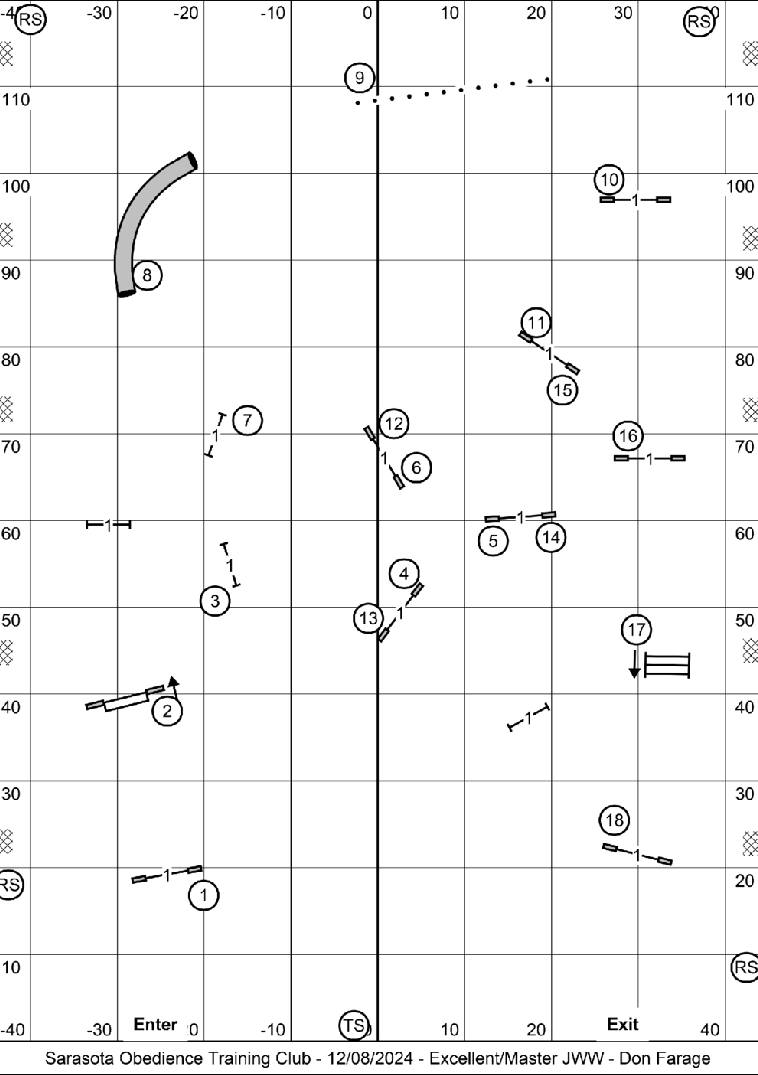
This weekend, I set up two Jumper courses to test Frankie's directionals. The first one was relatively straightforward. RIGHT RIGHT out of the weaves worked very well to turn her to jump 3. She has such wonderful distance that I was able to send her to jumps 5 through 8 while I stayed in the middle of the course. I called her to me over 8 then told her RIGHT RIGHT again to turn her over 9. This is a rear cross on the flat. To turn her over 13 and keep her off that off course jump 5, I told her RIGHT RIGHT TUNNEL. Then one more rear cross on the flat with RIGHT RIGHT to turn her over 17 to the last jump at 18. She had several clean runs on this course. Archie did too although I handled him in a more traditional way.


Today, I set up this more challenging Jumpers course. Yeah, that crowded bit in the middle was really tricky. Frankie only had a single clean run, our last run of the morning after almost hours of practice. But what a clean run it was! My verbal timing was good, she listened and responded and kept all the bars up, and even had a beautiful GO ON at the end to finish the last two jumps way ahead of me. 

As you can see from the labels, both of these are Excellent/Masters level courses. 


We may not be in Novice Jumpers for too much longer!

Monday, June 24, 2024

Oh, Frankie!

 So I'm trying to run Frankie at trials now. She's quite the handful. She is blazing fast, heedless of personal safety, and has some strong opinions about what she is supposed to do out there.

At our most recent, rather disastrous, attempt at trialing, a friend asked me, how's her start line? And I had to admit that it wasn't great. He replied, if you start a run with chaos, then the entire run will be chaos. 

I've been thinking about this every day for the past three weeks. It's a great example of how advanced handlers can readily see problems and solutions for other handlers and dogs but get a bit blind when it comes to our own situation. His comment spurred me to dig deeper into Frankie's training, and to go back and retrain a lot of her behaviors. 

She is unlike any other fox terrier I've worked with. She is astonishingly smart and relatively easy to train since she is both toy- and food-motivated, which gives me lots of options for rewards, but I'm having to learn how to work with unexpected minutiae of behavior that I never saw in my other dogs. 

Frankie has also made me rethink how I train, literally the mechanics of how I approach teaching, rewarding, and reinforcing behaviors. The most important change is that I can't fix problems in the moment. With Frankie, I need to keep going forward no matter what. If I stop, regroup and redirect her to fix something, like ask her to repeat a contact, she blows up. She becomes so over-aroused and so anxious that she can no longer perform at all. I can only note the problem so I can isolate it later in a separate training session. 

The second most important change is that I need to keep her training sessions very short. The longer she works, the more overstimulated she becomes, and our connection becomes very fragile. 

There are many, many dogs whose stress and anxiety produces the opposite: when they shut down, they disconnect, walk away, stop performing, sniff, leave the ring, etc. When Frankie tips into over-arousal, she doesn't want to leave but she's not able to actually do anything. She has big emotions and big energy but doesn't know what to do with them. It's my job to monitor her and manage her training so that we finish before she reaches that state. It doesn't take long, sometimes just 10 or 20 seconds.

And the third thing I've learned is that I need to stop micromanaging her and put the responsibility of self control onto her. There is no physical reason she can't easily clear the jumps, no physical reason she can't hold a start line stay, no physical reason she can't stop on the contacts. It's all mental control. I have gone back to the very basics of these behaviors and am retraining them with criteria that are more clear to both of us. 

Our journey is a bit rocky now but I know that I will be a much better trainer and handler with her as my partner.


Sunday, June 25, 2017

Archie and The Purgatory of Open

Open is what AKC calls the intermediate agility level. As a friend remarked to me, Open courses aren't really designed, they are what is left over after you take away an obstacle or two from the Excellent/Masters class. Sadly, this is very true.

Open classes in this part of the US are usually quite small, often no more than 12 or 15 dogs from all height classes combined. Archie was the only dog in his height class for most of the weekend.

Some dogs zoom through Open, advancing in just a trial or two to Excellent. After all, to successfully complete Open courses, a dog has to already have Excellent-level performance skills. But because you don't have to many skills at all to get there, other dogs spend quite a bit of time at the Open level. Open has a bit of a reputation for accumulating dogs who just aren't going to do well in agility. On Friday, the judge welcomed us to the "purgatory of Open"--and she wasn't really joking. There are many reasons that a dog may need to stay in Open for a while: dogs may be physically structured such that agility will never be a good fit for them, some dogs just don't like the game and their handlers haven't figured that out yet, handlers and dogs may not yet have the skills they need to succeed, and so forth.

Given how well Archie performs in class, I assumed his time in Open would be brief. But we've now been in Open for four trials and only had four Qs out of a total of 14 runs at this level; this weekend we were 0 for 6.

I was feeling quite frustrated yesterday. But I realized today that I was missing something very important. It wasn't really the heat, although that may have been a factor. Archie simply isn't ready to advance to Excellent yet. His head is not yet in the game.

Ironically, I started the weekend worrying about something completely different. This was our first time at this particular venue. It is an open, dirt-floored horse arena. The fencing is even less complete than at most other places, and the arena itself doesn't even have walls all the way around. There were places where there was nothing more than horse railings separating the dogs from the enormous and exciting world outside. Horse railings with the lowermost bar almost 18" from the ground, hardly a barrier at all to a dog the size of Archie. He already demonstrated that he could get through the usual plastic fencing. I was sure he'd take one look at that horse railing and dive under it and be gone.

Yes, I have a young terrier who I don't trust off-leash. Judge away. I'm sure some of my agility-savvy readers are thinking, then why are you doing agility with him? Well, I don't like to stereotype breeds but...I'm going to revert to a stereotype: terriers are really difficult dogs to manage off-leash. The thought of unhooking my dog from a leash is terrifying. It's like Pandora's box--I have no idea what might happen, although all that I imagine is pretty horrible.

The irony is this: Archie never even glanced at the horse railing. I don't think he even noticed they were there. What he did notice was the hot dogs that a competitor left on a dolly outside the ring. He could barely function inside the ring, pulled magnetically toward those hot dogs after every obstacle. I gave up fighting him halfway through that run and carried him out of the ring. Today, he noticed that someone had eaten takeaway pizza and had left the box outside the ring on the ground. I literally forced him to complete that run. He had so many refusals and other errors while trying to figure out if he could leave the ring to get to the pizza box that we lost the Q quite early on. Our standard run earlier today was so bad that at one point the judge said "I don't know what errors I am supposed to call now!" (Archie had just gotten on the teeter, immediately turned around and did a perfect two-on-two-off contact on the entrance to the teeter, thus failing to execute the teeter and calling the "four-paw rule" into play. It was a clusterfuck.)

So I learned some hard lessons this weekend. The good news is that my pup will come back to me when I call. The bad news is that he will run off if he smells even a molecule of something delicious that he thinks he might be able to get to. Agility itself is not yet enough of a reward that he will choose that first.

I told Archie that I will be ready when he is ready. And I have some plans to help him along. He will be running agility with an increasing number of distractions (think plastic containers with food that he can't get to). He won't get high-value treats on course anymore--those will only come after he is leashed and we return together to his crate. I love my fabulous puppy very much, and am frustrated that he is so young and naughty. But I am glad that I was able to take a step back and recognize that we need some more training.

As a friend remarked this afternoon, when he's on, he's brilliant. Yes, but his moments of brilliance are not yet course-length in duration. We'll get there. I'm sure of it.

Sunday, February 19, 2017

CircusK9 Agility Update

One of the nice collateral benefits of all the training I've been doing with Archie is that Mimi gets lots more training too. She gets to go along for every fun run, which she totally adores. I've mentioned that I test my backyard setups with her first. And even though she is far more enthused about playing around in agility than competing, I enter her for agility trials too. The lower jump heights in the AKC Preferred class mean that she jumps 12" instead of 16" but I think that even that is rather too much so I no longer ask her to run Jumpers courses. She has managed to pick up several Qs and a title because even though she isn't all that fast anymore, she's reliable and her contacts are much more consistent than they used to be--all that contact board work makes a difference!

I have yet to get decent (and decently priced) photos or video of Archie running at a trial but I did get some very nice photos of Mimi a couple of weekends ago. There are several vendors in this area that take photos or video during agility trials then sell those to handlers. In the low light and large open spaces of the typical enclosed horse arena where dog agility trials are usually held in this part of the world, it takes a specialized camera and lens to get good shots. Of course, many people have friends film their runs with iPads or their phones. Sometimes you want a really nice photo, so I always look at the vendor photos of Archie and Mimi at the shows, although I usually pass because the cost is just not reasonable. However, I picked up five digital photos of Mimi, full resolution, for $15. Here are two of them. 

Mimi looks so happy that you would never believe that she isn't into competing. One run a day seems to make her feel included without making her too stressed.


Even if I don't have competition photos of Archie, I do have one that I took at home after a big trial weekend. The green ribbons are for qualifying runs (Qs) and the purple and black ribbons are for a new title. He earned all of those ribbons in one day--pretty good for a naughty baby dog. 


Sunday, November 27, 2016

Archie and The "Spread" Jumps

Archie's agility instructor only competes in NADAC. I intend to take Archie mainly to AKC agility events. So what's the difference? Jumps may be replaced with hoops which sit directly on the ground; the dog runs through them with no jumping required. NADAC doesn't use the teeter. And NADAC doesn't use the spread jumps: the double jump, triple jump, and broad jump. 

NADAC also has a lot of games where distance handling is required. Archie has some mad distance skills for a novice dog. Many novice dogs have to be babied all the way to the obstacle. As long as I am clear and consistent, I can send Archie away from me 20 or 30 feet, sometimes more depending on the flow of the course. I can even do this with contact obstacles. That takes strong commitment to the obstacle on his part, and a deep understanding of what my signals mean and what he needs to do with respect to that obstacle. 

But he's entered in his first AKC trial at the end of December. And there is no question that he will encounter the double jump, the triple jump, the broad jump, and the teeter at that trial. He has never seen these obstacles in class.

I wasted no time in finding a solution to the teeter problem. During the summer, I ordered an aluminum base and prepared the plank myself. In September, Archie and I worked our way up from a tipping plank on the ground to full-height teeter. He's rather enthusiastic about doing the teeter, sometimes pulling off the line I am working with him to run off and do it on his own. Some dogs like tunnels, mine prefers the contact obstacles.

I only started jumping him at his full jump height (16") at the beginning of November so there was no point in working on the spreads until then. And I don't actually have any real spread jumps. Rather than spend more money, I decided to take a more DIY approach.

The double didn't pose much of a problem. It is a bi-direction obstacle with two bars at the dog's jump height spaced about 8 inches or so apart, and crossed bars below to give some depth perspective. It turned out to be quite easy to set two of my jumps next to each other. Archie figured this jump out very quickly, really in just one session. He has since learned how to turn and wrap the double. Rather than trying to micromanage it, I let him figure out that I will handle it like a jump but that he has to alter his take-off and landing points a little to accommodate it. 


I solved the triple problem using a similar, but far more rickety, arrangement. The triple can only be performed in one direction. There are three bars at ascending heights. The back of the jump is the highest bar. I taught Archie a new command with this one: hup. The command "over" works for jumps and for the double, but the triple requires that the dog choose a different point to take off and that he remains extended over the jump to safely clear it. This will also change his landing point. He figured this jump out very quickly too but didn't feel comfortable extending over it, instead using the fox terrier "boing"--most inefficient. Setting jumps before and after the triple and requiring him to approach the thing at speed seems to have solved the problem. Perhaps he senses how unstable this mess of PVC is because he never touches any part of it! 


The broad jump had me stumped for a while. It is a weird obstacle made out of long, narrow wooden steps. The width of the steps can be 6 or 8 inches, and you place several of them next to each other to make an obstacle whose width measures twice the dog's jump height, which in Archie's case would be 32 inches. The tops of the steps are usually sloped with the front a little bit lower. The obstacle as a whole doesn't ascend in height though. 

I finally hit on a quick, cheap solution. I bought a wooden shipping pallet for $4 and sawed off a couple of slats to make it close to the right jumping width (it was okay in the other dimension). I slapped a coat of white primer on the top and sides, then added "racing stripes" (as recommended by AKC to improve depth perspective). I used paint I already had from preparing my teeter plank. 


Then I set up jump standards on the four corners, and voila! A very ugly but workable facsimile of a broad jump. I use "hup" on this obstacle too. Archie needed the prompt of a jump bar in the middle of it for the first few times over it, but he figured this one out quickly too. At first, he sailed over it with his hind feet tucked way too far forward but adding jumps to the approach and exit to increase his speed helped him sort this out. 

Archie will never see equipment quite this crappy in competition, that's for sure. That wobbly triple I cobble together never looks the same two training sessions in a row. But I think that's okay. As part of learning the obstacle, he is learning that although there may be variations in its configuration, his performance of it will not change. He's proving to be a smart little dog who thinks on his feet. 

Wednesday, October 26, 2016

Archie: Making Good Choices

Archie has been making a lot of good choices lately. He is bringing me toys while I study to initiate play (bringing them right to my hand, not a coy drop in my vicinity). He is bringing me toys during play, also right to my hand. He is dropping toys on command during play, though sometimes I have to wait a few seconds before he complies. The latter two choices are particularly interesting because he is definitely past stimulation threshold when we play tug and retrieve. He is still able to think and respond even though he is very wound up.

Monday night in class, he made yet another good choice. As I mentioned in the previous post, the doing of agility is becoming the reward for him holding his start line stay. Even though I have stopped giving him distracting treats, I still have one major distraction: his collar and leash. I run him naked so I remove his collar (flat, nylon buckle collar) with the leash attached. If I drop them on the ground or, heaven forbid, toss them towards the end point of the sequence, he will jump out of his stay and run to investigate them. And once he breaks his stay, he tends to run around a bit checking out other things and even doing an obstacle or two. (I've added "not breaking stay when collar/leash are removed" to the list of things to work on this week.)

This behavior was initially quite extreme, and he missed his turn to run a few times when I had to go get him from the other side of the facility. It has been steadily decreasing over the past weeks. But he had a rather big breakthrough on his first run in class on Monday night. 

The first run is always the hardest for him. He's high as a kite, ready to go, but unfocused. I walked him out to the start point, asked him to sit, made eye contact, unclipped his collar and leash, told him to stay, then stepped away. He immediately took off in another direction, heading for a jump and some interesting boxes to sniff by a pillar in the training facility. I called him, once, calmly, "Archie, come!"...and he whipped around and came straight back to my side without even taking the jump.

That was an amazingly good choice. Combined with all of his other good choices, it tells me something very important. He is starting to value playing with me over self-rewarding by sniffing and running about. 

Of course, the desired behavior is that he not break his stay at all. But Archie is a work in progress. 

Tuesday, August 23, 2016

Sniffing Bugs and Chasing Shadows

Archie is certainly proving to be a challenging agility partner. At times he has amazing focus and ability. At other times, no matter how enthusiastically we start, after a few obstacles he's off sniffing bugs and chasing shadows. His trainer pointed out that this is a classic example of avoidance behavior. But what is at the root of this problem? What, exactly, is he avoiding? There are several possibilities.

I'm late in giving him information. I just have to point and Mimi will perform. I can crowd her line, flap my arms, and she forges ahead. But Archie needs time to process what I say, which means he needs the information early and clearly. When I'm late, he slows down or stops because he's not sure what he is supposed to do and we lose our connection. Then it's oh, look! Off to see what that bug is doing!

I'm sloppy in my handling. He is extraordinarily sensitive to my body position, far more than Mimi is. Certain handling moves that work great for her only confuse him. He likes it when I keep everything very simple. That's not to say that he's stupid, because he isn't, or that I can't execute complicated handling moves with him, because I can. But I need to focus on trimming out all of the unnecessary bits and watch my feet and shoulders and my path more closely. For example, this morning he had to execute a tunnel and two jumps in a straight line followed by a 90 degree turn to another tunnel (this was part of a longer sequence, and he had completed this section once already). The dogs were getting a good head of steam coming down the line, so timing their turn around the second jump was important. The goal is to have them collect before the jump and turn tightly around it, not jump it at full speed and in full extension then execute a joint-damaging turn on the ground. Instead of running straight ahead to the second jump then slowing at the approach, letting my path mimic the one I wanted him to take, I let my path drift laterally to the second tunnel (with my shoulders turned towards my drift direction). I said "tunnel" before he hit the second jump so that he had plenty of time to execute the turn. Instead, he pulled off that jump and came straight to me. In fact, he did exactly what my body language was very clearly telling him: he interpreted that I wanted him to come to the far end of the tunnel, where I was heading, instead of the end of the tunnel closest to that second jump, which I had already passed. See what I mean? There is no question that he is watching me very closely. But I need to get better control of what he sees!

I'm not giving him rewards often enough. His trainer suggested this morning that I need to build up his stamina--his mental stamina, because physically he's fabulous. He needs to receive a reward every three or four obstacles, at least for a while longer.

And finally, I may be drilling him, which he hates (in which case, he is voting with his feet and leaving), or I have overfaced him, presenting him with a challenge that he just can't figure out. Both are more easily fixed than my sloppy handling.

Any and all of these can apply at any moment in time then he's off with the bugs and the shadows.

I was feeling particularly frustrated last night during a casual practice session (not a formal lesson). Archie was a mess. His time in the ring was not productive for either of us. I fretted over it after I got home and went to bed. He should be doing better, I kept thinking.

Then I recalled Mimi and the dead rabbit. I don't recall if I've written about this on the blog (it would have been in the earliest years of the blog, pre-Saudi Arabia). She used to train outside in a very large field. When presented with an arc of jumps that took her down field in a particular direction, she would not complete the arc but would instead take off for the damned lower forty. She always ended up at the same spot, sniffing and pawing excitedly. I was able to call her back, but she kept doing this. After a couple of weeks, I finally went all the way down there to see what she found so fascinating. 

It was a dead rabbit. A very long-dead rabbit. Just bits of bones, tendons, fur. A paw. Probably a dog or coyote kill.

A dead rabbit! How could I possibly compete against a dead rabbit? And that became a running line from her trainer: when you are more interesting to Mimi than a dead rabbit, you know you have found it, that special sweet spot in your training. I persisted, and in a few more weeks, we did in fact find that spot.

And with time and patience, so it will also happen with Archie.

Monday, March 28, 2016

Adorable and Smart

Archie has it all wrapped up in one feisty smooth fox terrier package.


-->
He got the nod from the instructor of his puppy class to advance to a beginning agility class—she said that he had a “solid foundation.” (preen, preen)


Yesterday, the last day of our spring break, there was just enough sun in the afternoon to take Archie’s training session outside. I had mowed the backyard on Friday so there was a relatively smooth surface for us to run around on. It’s been a battle with the grass: the non-stop rain makes it grow quickly, but there’s so much standing water that I often can’t mow in between rainstorms.


I’ve been working with him in the living room on the skill of going out around a cone. The determination of whether he goes to the left or right side of the cone depends on his position relative to me when I send him to the cone. That is, if he starts heading for the cone from my right side, he goes to the right side of the cone and turns back to me. I’ve been increasing the distance but that is pretty limited in the house!


So during our allotted five minutes of sun that day, I set up two cones and my tiny table with no legs. He’d never seen two cones at one time and he’d certainly not seen the tiny table. But his mat training is pretty solid so he picked up the concept of the table in just a few clicks: get on it, sit, and wait to be released. I gradually moved farther and farther from the table before releasing him and that seemed pretty solid. I then played some “ready, ready, go” games to send him to the table with speed and that seemed pretty solid.


Then I asked Archie to make a huge conceptual leap: sequencing. Cone-cone-table. Table-cone-table-other cone. I started slipping in front and rear crosses. Rate of reward was high but there was always a treat after he completed at least two obstacles in a row.


Archie didn’t even blink. No missteps. No hesitations. He even figured out on his own that instead of wrapping the cone in a tight 180 like he does in the living room, if I was heading to the table or the next cone, he needed to change the angle of his exit from the cone to also head in that direction.


I made absolutely sure to stop while he was high and happy. I can’t wait until the weather starts to dry out so we can play outside more regularly.

Monday, March 07, 2016

I Blame The Cat

Archie is growing like a little weed. An athletic, naughty little weed. To keep the naughtiness down to a low roar, he still has to navigate plenty of rules. If he goes outside and has a big, satisfying pee before I get in the shower, I allow him to run around with the other dogs. If he goes outside and farts around, he gets to sit in his crate while I shower. He's a quick learner. Today, he got to run around the house.

They still get into plenty of trouble but at least I know he won't pee on the floor somewhere.

I finished up in the bathroom this morning and went on a hunt for the dogs, only to discover Archie dragging the cat across the living room by his head. Just like Azza.

Good grief.

Sunday, February 28, 2016

Archie at the Dog Show

We first-year vet students are starting to crack under the pressure. We have so much material to review and learn in the next two weeks but we are all mentally exhausted. We needed a break!

About 15 miles up the freeway there was a big, four-day dog show that included conformation, agility, obedience, and rally. I knew it would also have a decent complement of vendors. So I convinced four of my fellow students to go on Saturday morning. Three of us brought dogs.

I decided this was the perfect time to see what Archie was going to do in that kind of scene. It would give me a feel for additional training that he might need.

Because he's still working on leash behavior, I thought that he should wear a harness instead of a collar. I found Harry's red harness from his Dogz Rule! flyball days and decided to use that. It was a good choice, and maybe it transmitted some good juju to my puppy.

I learned that Archie is the most chill, happy little fox terrier to grace this planet.

He didn't freak out over the chaos of the conformation arena, with the stench of cigarette smoke, baby powder, and dog pee underlain by a whiff of desperation. He didn't lunge at other dogs or jump on people.

No jumping unless they invited him to do so. Every single vendor selling food thought he was the cutest thing ever and started stuffing him with treat samples. He was into that. He was also perfectly happy to greet anybody willing to greet him (he's never met a stranger, as they say) with tail wags and kisses if they let him.

In the agility arena, he didn't stare into other dog's crates or try to grab treat bags from chairs. When we sat in the bleachers to watch some runs, he sat in my lap watching every single dog with great concentration and absorption. He didn't bark or whine or get wound up at the fast ones, but he never took his eyes off the dogs in the ring. Timers buzzing, teeters slapping the ground, judges calling points--none of this seemed to faze him. There were dogs all around us but he had eyes only for the ones in the rings.

I ran into two agility friends of my friend Anne, and, after greeting him, they immediately started asking Archie for sits and downs for treats. He was happy to comply with that as well--on a cold concrete floor surrounded by dogs and people. Amazing. You can always rely on dog people for some solid people-puppy interactions.

Archie is a delight and a challenge by equal turns. And I think we can call his first dog show a success.

Friday, February 12, 2016

Archie, Thirty Clicks, and Crate Games

Archie's training is proceeding at a brisk pace. He's the perfect study break. Of course his attention span is very short, although it is improving daily, along with his motor coordination. He still flings himself through life but his aim is a little better now. Even so, I keep his training sessions even shorter, which means sometimes I have less than three minutes to make things count. Planning is required.

Crate training is super important but it was on my list along with a couple of dozen other critical behaviors. By crate training I mean two specific things: the dog will run into the crate willingly and with enthusiasm then remain in the crate until released, even if the door is open. The general behavior of sitting quietly in a crate once the door is closed gets lumped into another category of skills.

To back up a bit, I have a crate for each of the dogs. It is their crate--other dogs aren't allowed in there. Mimi's crate is really just a hidey-hole for her, a place for her to chew on super high-value things. She sometimes naps in there when I'm studying since her crate is right next to me. But even though she has the run of the house during the day, she still has to get in her crate to receive a treat before I leave the house.

Azza and Archie have nice big crates that face each other across the living room. Both of them spend the day in their crates. Both of them have to get in their crates in order to get a treat before I leave.

The routine is this: once I do a final check of my backpack for the things I need for the morning, I say "get in your boxes!" as I go to the fridge to get a yummy soft treat for each dog. I have trained them to, and expect them to run, not walk, to their respective crates, dive in, and wait for me to deliver the treat.

Archie had to be formally introduced to those two specific behaviors I described earlier. I introduced "get in your box" using the clicker in three separate training sessions spaced about two days apart each. To keep Archie on his toes, I train three or four different behaviors in each training session. In sum, I probably went through thirty clicks and thirty treats on the "get in your box" behavior. Remember, I expect the dog to RUN into the crate with enthusiasm. I trained the release command separately, not in the context of the crate but in the context of sit-stay-release. Thirty treats may seem like a lot but I can deliver thirty treats in well under two minutes, depending on the clarity of my training and the focus of my dog--and these were spread out over three different training sessions.

I turned to working on other skills and put the crate training aside. Of course, Archie still had to get in his crate every morning. I simply opened the door and tossed a treat in for him. I'm not a purist and not at all above luring if it seems to be the appropriate tool at the time.

Imagine my astonishment when two days ago, after I said my usual (and invariable) "get in your boxes!" (it comes out more of a sing-song than a command) and headed for the fridge, I noticed Archie was not under my feet as usual. I turned the corner to find him standing in front of his crate. The door was pushed shut so he was looking at the crate, looking at me, looking at the crate, dancing back and forth on his toes, clearly communicating his desire to get in his crate right now! I opened the door and he shot into the crate like he'd been fired out of a gun, whipped around, and stared at me, waiting for his treat.

My jaw hit the floor.

Okay, sure, he's seen this behavior modeled by the other dogs day after day. I didn't specifically train the "wait in your crate until released" but he's seen them do that too. And I did train a stay-release sequence so he had the general idea.

I thought it was a fluke. I released him from the crate, and using the treat intended for Mimi, I said, "get in your box!" and he shot in the crate again! He's flawlessly repeated this behavior every morning and lunch time since. And at night, he now goes into his sleeping crate (pushed next to the bed) on his own.

To be clear, he never resisted going in his crate. I never had to stuff him in a crate against his will. And the breeder had him sleeping at night in a crate from about 10 weeks of age. Heck, he's already crossed international boundaries in a crate on a plane. He's traveled in cars in a crate. The crate isn't even the important part of this whole affair--it's really all about drive and excitement. What is huge about this leap is that he made it so quickly and with so little formal shaping on my part. He watches the other two dogs closely. He already loves the clicker so much that just the sight of it causes fox terrier boinging--training him at this point is a matter of his focus.

I could not have devised a more perfect diversion from the trials and tribulations of vet school.

Saturday, August 15, 2015

Playing at Agility

All summer, I've tried to set up some agility equipment for the dogs at least once a week. I know that doesn't seem like much but Mimi is too old to trial and Azza is, well, Azza is what she is. We just play at agility. But it's fun to test ourselves.

My work in the house with the cone and a jump bar during the winter really paid off. Azza has been embracing jumping, although she will only tackle jumps set to 8"; any taller and she will go around the jump. That's okay because I'd rather test her ability to learn and read my handling. She's been doing up to four jumps in sequence, she can read front crosses, serpentines, wraps, and sends to backsides, she will recall over a series of jumps, she loves loves loves the tunnel and my little table, and while she's not flying through the 2x2 weaves, she will eagerly trot through four poles that are nearly in line. She's in fact ready to have the third 2x2 added in. She seems much less worried about touching the metal base. However, she will never have lightening-fast weaves since that requires her to touch the poles, something she is careful not to do. She seems willing to play this strange game and have a bit of fun while she's at it.

A couple of weeks ago I introduced Azza to the joy of the bunny fur tug-n-treat. I play agility with Mimi with the bunny fur tug and Azza's been observing this for weeks. Using the clicker at first, then graduating to using the fur pouch itself and its delicious treats inside, Azza has learned to chase the thrown toy then return it to me for a treat, both rewarding behaviors for her. Sometimes I run with her to the toy so she gets the treat in place--as a result, she's decided the fur pouch is a rather interesting object.

I have also started working with Mimi on flipping away from me. I'm relying more on body motion signals than verbals, in particular the hand motions I use to have her spin in place in front of me. I used a flip away quite a bit with Iz but I never taught that to Mimi. She's picking it up very quickly.

My yard is small and my equipment is limited. I decide in advance what skill I'd like to work on then either find a bit of a published course or exercise that will do or I create my own. Most of the summer we've been working on going to backsides of jumps and weave entries. Even though there is a large skill gap between Mimi and Azza, if I put some thought and effort in it, I can come up with one setup that will work for both.

I generally work both dogs quite hard. Each dog gets three five-minute sessions and I alternate them so they get a chance to rest in between.

Here's the course's we've worked on in the past three weeks. I called the two shown below "Less is More." Yep, that's right, for one week, I worked the dogs for half an hour on only two jumps! Lots of practice with backsides and wraps. In the course on the left, you can barely see the two 2x2 weaves I put at the bottom of the course for Azza. Mimi did the six poles at the top of the course. That week we focused on weave entries.


I took the course section shown below out of a Clean Run article analysing the 2015 AKC International Team Tryouts Jumpers course. I only set up the part in the orange box and I added my little table at the position of the orange star. We had great fun with this. Some tough challenges if you decide to have the dog take the backside of every jump. I plan to set up the part at the top next week to work on funky tunnel entrances and exits.


You might be thinking, what's the point if we aren't competing? I would answer that agility challenges the dogs and keeps their little neurons whirring. It's good exercise for all of us. We get to run around the yard in the cool mornings. Treats and lots of praise and excitement are included, which we all like. And it's fun!

Saturday, March 07, 2015

Cones and Clickers

-->
It’s almost springtime in the Pacific Northwest. We had a mild winter so the transition has been a subtle change from cold and damp to cold and less damp. Cold is relative, of course. I mentioned the freezing pre-dawn temps that I work in at the barn (the last cow had her calf this morning; we are almost done), but once the sun comes up, things warm up nicely. In other words, our winter has not been nearly as intense as what the rest of the US has been experiencing these past few weeks.
Even with the drier weather, the ground is still far too muddy to do much outside. My schedule with the cow project has been rather hectic and I come and go a lot. Since I always give the dogs a treat before I go, I plan ahead and do a few minutes of training with them a couple of times a day.
Azza is about as mature and stable as she will probably ever be so I decided to try her again on simple agility equipment. I’m only using a cone and a jump bar. And I’m using a clicker. She never really took to the clicker before but she’s pretty into it now. I wonder how much of her enthusiasm comes from sitting on the couch just a foot or two from Mimi, whose level of excitement for clicker training is quite impressive.
One of my training goals is to have the non-working dog wait quietly in one spot while I train the other dog. No crate, no restraint. But no barking or whining or leaving that spot. I frequently click and treat the dog who is staying quietly in the spot. It’s good for the working dog to see this--both of them have to get on board with the idea of sharing training time and space.
Another training goal is to have the dogs reliably go out and around a cone. I'd like to set them up to work backsides of jumps when we can get outside and have more room. Mimi’s problem has always been too much handler focus so I work more distance with her. Azza, well, I just want her to go around the darned cone. At first all she wanted to do was touch it with her nose or paw--excellent, rewardable behavior in most circumstances but not what I wanted. Sometimes I lay a jump bar on the ground with the cone at one end. Azza has been particularly afraid of the jump bars. But she has been doing extremely well with this exercise, diving around the cone with quite a bit of momentum, and taking a little hop over the bar without stopping to worry about it or acting like it will bite her. My long term goal is to get her to reliably jump real agility jumps set with low bars, say, 12 inches. She is of course physically capable of clearing much higher jumps but I just don’t think that is a realistic goal. If she touches any part of a jump, she shuts down. And if she knocks a bar, well, it may take days before she’ll even approach the jump again. So for now, it is a bar on the ground and a cone.
I also decided to convert two of Mimi’s behaviors into verbal cues only. She has a “spin” (she turns to her right) and “turn” (she turns to her left). I use verbals for these commands but she responds mainly to the hand signals. She is handed and performs the spin much better, faster, and more consistently. So I worked on the turn for a few days to get it in better shape, then I started fading out the hand signals for both, making them smaller and smaller until I reduced them to a finger twitch. I’m now insisting on the behaviors with verbal only. It’s funny to watch Mimi process this. She KNOWS what I mean when I say “turn” but she tries half the behaviors in her repertoire before she will do the turn without any body motion from me. She often tries the rally obedience “around” in which she moves from a position facing me, around my back, into heel position on the left side. She’ll try this two or three times, spinning in tight loops around me. And she always falls back on her favorite trick “beep beep” in which she backs up while facing me. But she is definitely making progress. It's a silly game, really, but she certainly enjoys it.
And the last trick that I'm working on is the two-dog heel. Mimi has been trained to heel on the left side. That's conventional. But for dog management purposes, I trained Azza to heel on the right. I happen to use the exact same phrase for both of them: get ready. So I'm working on putting them in sit stays facing me from a few feet away, then releasing them at the same time and having them get into heel position at the same time, one on each side of me. Also a silly game but quite amusing for me.
Let’s be honest here. Mimi’s agility competition days are long behind her. Azza will never compete in agility. That environment is far too complex for her to deal with. But there’s no reason not to keep their minds challenged and their bodies active. They like the extra treats too, of course, but having all my attention focused on them is certainly motivating for both of them.

Sunday, November 17, 2013

Achieving Satori

Skills that your dog learns in one context can often be useful in another, often in unexpected ways.

In Dhahran, me and P and M regularly walked our dogs together in the evenings. I've written before about our efforts to find empty houses with good yards so we could let the dogs run around and be crazy. The best houses were the ones with the water still turned on. Even better were the ones with a hose attached to the spigot. It was nasty, reclaimed water but the dogs were most appreciative of a chance to get a drink.

Over the course of a hot summer, P taught Azza how to drink from a hose. This was a rather laborious process starting with convincing Azza not to be afraid of the hose. By the time we left Dhahran, P could pick up a hose and Azza would stand in line for her turn.

My first satori moment occurred this weekend when I was hosing Mimi and Azza off after they had gleefully played in the leaves for half an hour. They were covered head to toe in mud. The path of least resistance for dealing with that is to hose them off outside then towel them off inside on the mat by the back door. I realized as I was rinsing mud off Azza's neck and legs that not only was she willing to let me do this, she even came when I called, standing there with a running hose in my hand. I don't think that even P could have predicted this back when she decided that Azza needed to learn how to drink from a hose.

My friend DSL came to visit me here in Oregon in September. She was goofing around with Azza and, noting that Azza uses her paws to request attention, starting casually playing a "give me your paw" game. She switched around her hands and asked for one or the other paw. Nothing formal with a clicker but DSL played this several times with Azza during her visit. Azza really took to this game. I decided to make it a little more formal so we now have the "give me your paw-give me your other paw" game. The satori moment? When we play this game, it can completely deflect one of Azza's meltdowns. The moment she gets worried about something, I call her over to play a few rounds of this. It takes a lot of concentration on her part because she has to completely shift her center of balance to give me alternate paws in quick succession. By the time we are done, she's forgotten all about whatever it was that set her off. Another unpredicted outcome of the original game.

Dogs are amazing learners. Azza isn't special--lots of dogs can apply a skill learned in one context to another. What's neat about this is that sometimes we get to learn new things too.