My closest colleague at work is a Chinese guy. He has a BSVM from a Chinese university, which is educationally equivalent to a DVM. He has not completed the (difficult and expensive) program that would certify him to practice as a DVM in the U.S. But he has the same job title as me, and in the 18-month gap when they were looking to fill my position that also included the 6 or so months that they had to wait for me to finish vet school, he conducted nearly all of the non-poultry necropsies that came through the lab. And for the last three months of that period, he had to do the poultry necropsies too. (For the record, he doesn't like working with birds, which is fine by me as I really like doing avian necropsies.)
Since I started working in July, I have completed over 150 necropsies in multiple species. I split each week's cases with my colleague. Using those numbers, by my back-of-the-envelope-calculation, he likely handled over 500 necropsies during the period that he was on his own. This gave him an incredible breadth and depth of experience, and a deep understanding of pathology of disease.
I find working with him to be quite enjoyable. He's got a dry sense of humor and a keen eye for detail. He and I have different styles on the necropsy floor (one time he put the entire head of a cat in formalin for reasons I still haven't been able to discern), but our styles are compatible so we work very well together. We discuss our active cases every day. We trade cases. We ask each other to look over necropsy reports before they get sent out. We argue about differentials (the director is particularly amused by this as we can get rather excited and loud). We cite papers at each other. We call the other one down to necropsy if we have a particularly interesting finding. I was able to ramp up my own performance very quickly by relying on him for advice, which he shared freely. He is professional, courteous, smart, thinks outside the box, and is happy to indulge in black humor when we need to blow off steam. What's not to like about having a colleague like that?
All of this is an introduction to what I really wanted to rant about. I have learned that my predecessors did not regard my colleague in the same way that I do. When one of the pathologists took him on the necropsy floor to teach him the basics, the other two pathologists ran to the director clutching their pearls, aghast and appalled, complaining that he was transgressing a sacred space. It's of a piece with those two refusing to share any details of their cases with anyone else. I also suspect microaggressive racism lurking around the edges of their behavior, but that is only my opinion. In short, my colleague was dismissed, overlooked, and treated quite unprofessionally.
In contrast, I have come to rely on my colleague. And the feeling is mutual! He tells me often how much he enjoys working with me, that he and I make a great team, that he has my back as I take over as supervisor of our section of the lab. He has no interest in being a visible leader himself, but without a doubt he leads by his actions.
The director has told me several times about a police K9 case from a few years ago that was handled quite poorly by one of the aforementioned pearl-clutchers. I don't have all the details but the necropsy wasn't done promptly, the necropsied body was kept for months instead of being released, and the report was treated like it contained state secrets. The mishandling and delays resulted in bad publicity for the lab.
Yesterday, on Christmas Eve, around noon, I got a call from the police chief of a small Arkansas town about 75 miles from Little Rock. A police K9 had been found dead and they wanted to bring him in for a necropsy. I don't typically have to work nights or weekends or holidays, but there are a few rare exceptions, and police K9s are one. The chief and I worked out details of timing. And the very next person that I called was my colleague. "I know you are on vacation, and it's a holiday on top of that, but I need your help," I told him. He said, "Absolutely, we are a team. When do I need to be there?" My second call was to the director to assure him that we had this case well in hand.
I ran the necropsy and my colleague acted as my tech, fetching things, taking pictures, managing my necropsy table. The gross findings were definitive, and we were able to determine a cause of death, document it properly, and get the two police officers back on their way home in about an hour. The director will be over the moon. As I drove home, I reflected on how much I have learned from my colleague in the past few months. Our job is unusual and can be physically and emotionally difficult at times. We are going to be more successful if we work together.
I am ashamed that my colleague was treated so poorly in the past, and even though I know that it wasn't my fault or my doing, and that I can't make up for years of poor treatment, I am reaping the benefits of choosing to treat him with the respect and professionalism that he is due.
Thursday, December 26, 2019

Wednesday, December 25, 2019
Orange Basil Lentil Salad
I haven't posted a recipe in quite a while. This is a salad that I've now made twice, with good repeatability. The first time I came up with it, I took it to a party where it was complimented by all. No leftovers either. Yes, it was a bit risky to take a dish I literally created on the spot to a party, but I'm pretty confident in my cooking skills. I made it again last night for my Xmas Eve dinner. Total prep time is about an hour if you take time to drink a glass or two of pinot gris while you are puttering about in the kitchen.
Lentils, 1 to 2 cups dried
Fresh basil, lots
Red onion
Feta cheese crumbles, 6 oz or so (one small container)
Navel orange (one or two depending on size)
Dried cranberries, about 1/2 to 2/3 cup
Fresh greens (arugula, spinach, mixed greens, etc)
Olive oil
Honey
Apple cider vinegar (optional)
Black pepper, fresh ground
Rinse the lentils in a strainer. Cook 1 to 2 cups of lentils on low to medium heat (simmer, don't boil). Don't worry about having extra water as you can drain that off. Use French green lentils if you want to be fancy. Set the lentils aside to cool. When cool, put 1 to 2 cups cooked lentils, drained, in a large salad bowl. The lentils don't take long at all to cook. You can make them ahead of time if you want.
Finely slice a red onion and caramelize with some olive oil. This will take about 20 minutes on low to medium heat. Stir often. Set aside to cool. When cool to the touch, add to the large salad bowl.
Put the feta cheese into the large salad bowl.
Add a large handful of dried cranberries to the large salad bowl.
Finely dice a very large handful of fresh basil leaves. Put 1/3 of the leaves in a measuring cup and put the rest in the large salad bowl.
Note that the order in which you add things to the salad bowl is not actually all that important. Don't add the lentils and onions until they are cool though.
I find this recipe only needs 1 large navel orange but you could use two if you wanted. You might want to increase honey and basil if you use two oranges. Cut the navel orange into quarters and peel two of the quarters and divide into sections. Slice the sections into 1 cm-long pieces and add to the large salad bowl. Squeeze the juice out of the other two quarters into the measuring cup.
To the measuring cup, add some olive oil, a tablespoon of honey, and lots of fresh ground black pepper. If you want the dressing to have more of a bite, add 1/2 tablespoon of apple cider vinegar. Otherwise, it will be fairly sweet. Stir very well to dissolve the honey and mix the oil and orange juice.

Add your greens to the salad bowl. Fill that bowl up! Give the dressing another good stir and pour over the top. Gently mix everything well. Enjoy!
Lentils, 1 to 2 cups dried
Fresh basil, lots
Red onion
Feta cheese crumbles, 6 oz or so (one small container)
Navel orange (one or two depending on size)
Dried cranberries, about 1/2 to 2/3 cup
Fresh greens (arugula, spinach, mixed greens, etc)
Olive oil
Honey
Apple cider vinegar (optional)
Black pepper, fresh ground
Rinse the lentils in a strainer. Cook 1 to 2 cups of lentils on low to medium heat (simmer, don't boil). Don't worry about having extra water as you can drain that off. Use French green lentils if you want to be fancy. Set the lentils aside to cool. When cool, put 1 to 2 cups cooked lentils, drained, in a large salad bowl. The lentils don't take long at all to cook. You can make them ahead of time if you want.
Finely slice a red onion and caramelize with some olive oil. This will take about 20 minutes on low to medium heat. Stir often. Set aside to cool. When cool to the touch, add to the large salad bowl.
Put the feta cheese into the large salad bowl.
Add a large handful of dried cranberries to the large salad bowl.
Finely dice a very large handful of fresh basil leaves. Put 1/3 of the leaves in a measuring cup and put the rest in the large salad bowl.
Note that the order in which you add things to the salad bowl is not actually all that important. Don't add the lentils and onions until they are cool though.
 |
| I like feta cheese and used an entire small container. Feel free to exercise more restraint. |
I find this recipe only needs 1 large navel orange but you could use two if you wanted. You might want to increase honey and basil if you use two oranges. Cut the navel orange into quarters and peel two of the quarters and divide into sections. Slice the sections into 1 cm-long pieces and add to the large salad bowl. Squeeze the juice out of the other two quarters into the measuring cup.
To the measuring cup, add some olive oil, a tablespoon of honey, and lots of fresh ground black pepper. If you want the dressing to have more of a bite, add 1/2 tablespoon of apple cider vinegar. Otherwise, it will be fairly sweet. Stir very well to dissolve the honey and mix the oil and orange juice.

Add your greens to the salad bowl. Fill that bowl up! Give the dressing another good stir and pour over the top. Gently mix everything well. Enjoy!
Sunday, December 22, 2019
"You mean they are calling to talk to you about patients that are still living?"
Even though I'm a brand new veterinarian and shiny new gross pathologist, I've got more than two decades of experience as a scientific professional behind me. As a result, I just assumed that I should be doing certain things in my own workflows. For example, I always call the referring veterinarian when I finish a necropsy, usually even before I write my report, and let them know my preliminary findings. Sometimes I don't have a veterinarian contact, so I talk to the poultry house manager or the owner of the beef cow. But the important point is that within a few hours of submitting animal remains for necropsy, our stakeholders get a brief report directly from me. I also started calling vets who submit biopsies, mostly to let them know they sent us an alien baby tissue sample in a woefully inadequate amount of formalin and it would take us a few more days to properly fix the tissue before we could cut it in.
Since making these phone calls seemed to be reasonable and minimally professional, and really didn't take much time at all, you can imagine how astonished I was to learn that the previous holders of my particular job never did these things. Never. Necropsy cases might be open for weeks, and the results never discussed with anyone. One previous pathologist put a sign on his closed office door (the office that I occupy now) stating that he was not to be disturbed for any reason. He never answered his phone either.
My office door is always open. The super nice but very large microscope that I use was deliberately positioned on the desk so that it formed an imposing physical barrier facing the door. I moved it to a small desk on the other side of the room. The light from the windows can be a bit bright sometimes, but I felt that was a small price to pay for getting rid of the physical wall that was between me and everyone else.
I'd been happily rolling along for several months, picking up the phone just about every day to talk to our referring vets, who are located all over the state (I had to put up some maps of counties and cities in Arkansas so I could figure out where these folks were located). Since I assumed this was basic professional courtesy, I was unprepared when one of those vets, who works in a three-vet, mixed animal practice that sends us a ton of necropsy cases, told me that I was a "breath of fresh air" and that I couldn't ever leave the lab. She called me a "treasure." Not much can leave me speechless but I found myself stammering out a reply. And in fact, this happened more than once. Nobody else called me a treasure, but several vets told me that they were extremely appreciative of my efforts to reach out to them about their cases.
Shortly after that, I noticed that vets were calling me. And they were calling to... chat. They would describe some puzzling case they were working on in their clinic then ask my opinion on this or that diagnosis or treatment, often prompting me to look at the phone handset and think, wow, they think I know what I'm doing here. But my geological science background made me very comfortable with exploring a problem with multiple hypotheses that may be overlapping or even mutually exclusive. I can do that with vet med problems too. I am not a naturally glib person, but I love to gab about science, and I always learn new things when I talk to fellow scientists. It seems that my veterinarian colleagues out there in clinics across the state like to gab too, and have decided that I'm either a resource with decent suggestions, or at least a good listener.
I relayed this to the lab director, and he paused then somewhat incredulously said, "You mean to tell me that the vets are calling to talk to you about patients that are still living?" I paused, surprised, and said, "Yes, I think that's exactly what I'm telling you." And he said, "Nobody in your role in this lab has ever accomplished this."
Accomplished simply because I chose to be an engaged professional.
Since making these phone calls seemed to be reasonable and minimally professional, and really didn't take much time at all, you can imagine how astonished I was to learn that the previous holders of my particular job never did these things. Never. Necropsy cases might be open for weeks, and the results never discussed with anyone. One previous pathologist put a sign on his closed office door (the office that I occupy now) stating that he was not to be disturbed for any reason. He never answered his phone either.
My office door is always open. The super nice but very large microscope that I use was deliberately positioned on the desk so that it formed an imposing physical barrier facing the door. I moved it to a small desk on the other side of the room. The light from the windows can be a bit bright sometimes, but I felt that was a small price to pay for getting rid of the physical wall that was between me and everyone else.
I'd been happily rolling along for several months, picking up the phone just about every day to talk to our referring vets, who are located all over the state (I had to put up some maps of counties and cities in Arkansas so I could figure out where these folks were located). Since I assumed this was basic professional courtesy, I was unprepared when one of those vets, who works in a three-vet, mixed animal practice that sends us a ton of necropsy cases, told me that I was a "breath of fresh air" and that I couldn't ever leave the lab. She called me a "treasure." Not much can leave me speechless but I found myself stammering out a reply. And in fact, this happened more than once. Nobody else called me a treasure, but several vets told me that they were extremely appreciative of my efforts to reach out to them about their cases.
Shortly after that, I noticed that vets were calling me. And they were calling to... chat. They would describe some puzzling case they were working on in their clinic then ask my opinion on this or that diagnosis or treatment, often prompting me to look at the phone handset and think, wow, they think I know what I'm doing here. But my geological science background made me very comfortable with exploring a problem with multiple hypotheses that may be overlapping or even mutually exclusive. I can do that with vet med problems too. I am not a naturally glib person, but I love to gab about science, and I always learn new things when I talk to fellow scientists. It seems that my veterinarian colleagues out there in clinics across the state like to gab too, and have decided that I'm either a resource with decent suggestions, or at least a good listener.
I relayed this to the lab director, and he paused then somewhat incredulously said, "You mean to tell me that the vets are calling to talk to you about patients that are still living?" I paused, surprised, and said, "Yes, I think that's exactly what I'm telling you." And he said, "Nobody in your role in this lab has ever accomplished this."
Accomplished simply because I chose to be an engaged professional.
Sunday, December 15, 2019
For Now, I Have To Pass On That
Cooking has been a hobby of mine for years. Combined with all the travel that I've done, I consider myself a fairly adventurous eater. I pay attention to what I eat, and if I like a dish, I try to recreate it at home. I consider myself reasonably experienced in the kitchen to the point that, with the exception of pastries, I consider recipes to be more suggestive than prescriptive. (Why pastries? That shit has tighter engineering tolerances than manufacturing medical equipment.)
I've also been interested in vegetarian cooking for a very long time. I first learned of this way of cooking when I lived in a strict vegetarian, clothing-optional, coed co-op during my first pass through college almost 4 decades ago. I kept my clothes on but paid close attention when I was on kitchen duty with my housemates. Some of their ideas had a pretty big influence on me. For example, I rarely eat packaged food. I prefer to cook using good quality raw ingredients. It takes longer because all those raw ingredients have to be prepped in various ways, but I refer you back to my first point--cooking is a hobby. It's something in which I invest time and emotional energy. And my diet has always included a decent proportion of vegetables and grains. One of my go-to comfort meals, tofu sauteed with onion and spinach then sprinkled with fresh lime juice, is all the way onto the vegan side of the scale.
Fast forward to now. About a month ago, I realized that I hadn't purchased any meat in the previous couple of months. Somehow, in a shift that was subtle enough that I didn't consciously recognize it for months, I've become vegetarian.
I realized it had a lot to do with my new job. I handle dead animals regularly. Well, that's a flat-out euphemism. I cut them up. I cut up dead animals of all species. I surgically take them apart. After I remove entire organ systems, I cut those up too to make sure no lesions are overlooked. That was all soaking into my head too, just like those early cooking lessons, so that when I was at the grocery store doing my shopping on the weekends, I'd walk past the meat section and just...keep walking.
It's not a moral issue. I'm not a smug vegan judging you for your choices. You will have to pry the half-and-half in my morning coffee and yogurt and eggs from my cold, dead hands. Grated parmesan is a perfect garnish for just about anything.
For now, I still eat meat if someone makes it and serves it to me. It seems to be the handling of it that bothers me the most. And I've finally found the perfect agility training reward for Archie--boiled beef. Low fat, low sodium, freezes well, and he just goes nuts for it. I buy the pre-cut stir-fry strips and I don't even have to handle them when raw, just dump them in a saucepan and add water.
Is it just a phase? Does it matter if it isn't? It's sure a lot cheaper. Maybe I'll lose some weight too.
I've also been interested in vegetarian cooking for a very long time. I first learned of this way of cooking when I lived in a strict vegetarian, clothing-optional, coed co-op during my first pass through college almost 4 decades ago. I kept my clothes on but paid close attention when I was on kitchen duty with my housemates. Some of their ideas had a pretty big influence on me. For example, I rarely eat packaged food. I prefer to cook using good quality raw ingredients. It takes longer because all those raw ingredients have to be prepped in various ways, but I refer you back to my first point--cooking is a hobby. It's something in which I invest time and emotional energy. And my diet has always included a decent proportion of vegetables and grains. One of my go-to comfort meals, tofu sauteed with onion and spinach then sprinkled with fresh lime juice, is all the way onto the vegan side of the scale.
 |
| A sample of the things I cooked this weekend for the upcoming week: cornbread muffins; white beans with roasted garlic, carrots, and fresh basil; white rice; and roast cauliflower and mushrooms with black pepper. |
Fast forward to now. About a month ago, I realized that I hadn't purchased any meat in the previous couple of months. Somehow, in a shift that was subtle enough that I didn't consciously recognize it for months, I've become vegetarian.
I realized it had a lot to do with my new job. I handle dead animals regularly. Well, that's a flat-out euphemism. I cut them up. I cut up dead animals of all species. I surgically take them apart. After I remove entire organ systems, I cut those up too to make sure no lesions are overlooked. That was all soaking into my head too, just like those early cooking lessons, so that when I was at the grocery store doing my shopping on the weekends, I'd walk past the meat section and just...keep walking.
It's not a moral issue. I'm not a smug vegan judging you for your choices. You will have to pry the half-and-half in my morning coffee and yogurt and eggs from my cold, dead hands. Grated parmesan is a perfect garnish for just about anything.
For now, I still eat meat if someone makes it and serves it to me. It seems to be the handling of it that bothers me the most. And I've finally found the perfect agility training reward for Archie--boiled beef. Low fat, low sodium, freezes well, and he just goes nuts for it. I buy the pre-cut stir-fry strips and I don't even have to handle them when raw, just dump them in a saucepan and add water.
Is it just a phase? Does it matter if it isn't? It's sure a lot cheaper. Maybe I'll lose some weight too.
Saturday, December 07, 2019
Polishing That Resume
I was busy this week buffing up the resume credentials.
I am now certified to operate our forklift. I'm sure you are asking why I would ever need this skill. Well, we generate a fair bit of biological waste in the Necropsy unit, and we've got to dispose of it somehow. And "somehow" has to conform to an array of laws and regulations. We have a brand-new incinerator in a maintenance yard across the street from the lab, and we use the forklift to lift a specialized bag containing said biological waste out of a container and up into the incinerator. We typically burn between 1000 and 1500 lb of material at a time. That's not really a lot, since an average horse or cow weighs 1000 lb. Nobody at the lab was certified to run the forklift, so I arranged for the training and now 8 of us are certified. Plenty of hands to help whenever we need to burn a load of waste.
This week I also attended a day-long continuing education event on Arkansas aquaculture. I learned about the species that are cultivated in the state, and about important commercial fish diseases and parasites. After lunch, we had hands-on activities doing necropsies and looking over some lab testing procedures. I successfully pulled 3 mL of blood from my little catfish.

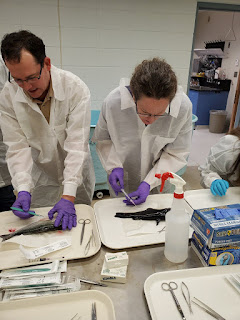
The necropsy part was great. I knew absolutely nothing about fish anatomy before the class, and boy, are fish weird. There are only two chambers in their hearts, although they kind of cheat on the chamber count and add a third structure that acts as a pressure regulator out of the ventricle. They have two long kidneys tucked up near their spine like mammals. In some fish, the function of the cranial part of the kidney can be different than the posterior part. Their kidneys have an excretory function but freshwater fish lack the structures to create concentrated urine, for example. And of course they don't have lungs or a diaphragm. They have very simple guts, basically a stomach and intestine. I was surprised to learn that they do not have cloacas like birds but have two separate outlets, one for urogenital things and one for poop. Comparative anatomy for the win!
I am now certified to operate our forklift. I'm sure you are asking why I would ever need this skill. Well, we generate a fair bit of biological waste in the Necropsy unit, and we've got to dispose of it somehow. And "somehow" has to conform to an array of laws and regulations. We have a brand-new incinerator in a maintenance yard across the street from the lab, and we use the forklift to lift a specialized bag containing said biological waste out of a container and up into the incinerator. We typically burn between 1000 and 1500 lb of material at a time. That's not really a lot, since an average horse or cow weighs 1000 lb. Nobody at the lab was certified to run the forklift, so I arranged for the training and now 8 of us are certified. Plenty of hands to help whenever we need to burn a load of waste.
This week I also attended a day-long continuing education event on Arkansas aquaculture. I learned about the species that are cultivated in the state, and about important commercial fish diseases and parasites. After lunch, we had hands-on activities doing necropsies and looking over some lab testing procedures. I successfully pulled 3 mL of blood from my little catfish.


The necropsy part was great. I knew absolutely nothing about fish anatomy before the class, and boy, are fish weird. There are only two chambers in their hearts, although they kind of cheat on the chamber count and add a third structure that acts as a pressure regulator out of the ventricle. They have two long kidneys tucked up near their spine like mammals. In some fish, the function of the cranial part of the kidney can be different than the posterior part. Their kidneys have an excretory function but freshwater fish lack the structures to create concentrated urine, for example. And of course they don't have lungs or a diaphragm. They have very simple guts, basically a stomach and intestine. I was surprised to learn that they do not have cloacas like birds but have two separate outlets, one for urogenital things and one for poop. Comparative anatomy for the win!
Friday, November 29, 2019
For Public Consumption
I've been struggling lately to find blog-worthy topics. I absolutely love my job. I look forward to getting into the lab every day. There's no way to predict what will walk in the door! Unfortunately, most of the stories that I can spin these days, based on events at work that I find interesting or amusing, are inappropriate for public retelling. And I don't think that I want to turn this blog into "Tales From The Necropsy Floor." Even most veterinarians don't want to see endless photos of diseased tissues in dead animals.
As an example of a story that isn't suitable for public consumption, consider the rabbit we received last week. Most of the small animal submissions we receive are wrapped in bags or tarps then placed in a cooler or box or some other opaque container. The rabbit arrived in a small cardboard box, taped up for shipping. The necropsy techs were at lunch so I told Receiving I'd carry the remains back to necropsy. I opened the box to look for the paperwork...and found the submission form folded up and laid on top of the rabbit. No other packaging, not even a WalMart bag. Just the dead rabbit and a folded up piece of paper in an otherwise empty cardboard box. There are several layers of subtext as to why this was funny...but I don't think I can spin any of them into an acceptable party tale.
Here's another example. My interest in laying hens and ovarian/oviductal cancer is underlain by a deeper interest in reproduction. I now have access to many different species of animal, and I've begun building a library of fixed tissues and slides of reproductive tissues, both with disease and without. We recently received a male sugar glider for necropsy. I did some research and learned that, like most marsupials, sugar gliders have some freaky ass reproductive organs. I walked in to necropsy, pulling on the heavy gloves we wear and snapping them in place just like they do on the TV, and announced to my two techs, "Sugar gliders have a forked penis. I'm adding this one to my collection." They just laughed. Yes, I am perfectly aware that writing it out like this makes me sound like a psychopath. But I've explained to them my interest in reproduction and my desire to understand both the gross and the microscopic appearance of reproductive tissues of all kinds of animals. So I deliberately collect those tissues even if they don't have anything to do with the cause of death of the animal. This is another aspect of my job that I can't discuss outside of work.
Here's a third example. Besides animal remains for necropsy, we also get surgical biopsies submitted by veterinarians located all over the state. These are lumps and bumps and masses that they remove from their patients and send to us so we can make slides and have a pathologist look at them to make a diagnosis. The basic process is for the submitting veterinarian to place the tissue in formalin. This chemical causes proteins in the tissue to become cross-linked so the tissue becomes stiff and sort of rubbery. We then cut thin pieces from the tissue, embed that in paraffin wax, then cut even thinner slices of that and mount it on a glass microscope slide. The tissue is stained, a cover slip is glued on, and then the pathologist gets that slide for interpretation.
When I took over supervisory duties for the Pathology section, I instituted several new QC processes, especially for the surgical biopsy submissions. There had been none in place before--apparently it was left up to the techs to decide how to cut up the submitted tissues. They would often slice up tumors in ways that suited them, but that did not produce diagnostic samples or slides. I now examine every biopsy submission and give the techs written instructions for key areas to focus on. Sometimes I give instructions to leave submissions in formalin for another 24-48 hours, or note that the sample is extremely fatty and needs to be placed in a different fixative.
Last week, we received a tissue sample from a young Great Dane bitch. It was an external "mass" that was growing adjacent to the vulva of the dog. The vet excised it and sent it to us in a pill bottle. Not a good choice--pill bottles leak, and formalin is hazardous. They didn't put enough formalin in the bottle and most of the tissue sample was uncovered. Suspecting that it wasn't adequately fixed, I pulled it out to take a look and promptly bonked my forehead on the glass door of the fume hood as I yelped "My god, it's an alien baby!" The tissue was so complex and so confusing that I immediately called the submitting veterinarian to find out more. Turns out she was just as perplexed as I was, and was hoping that we would tell her what it was. I tweaked her a bit for sending the damned thing in a leaking pill bottle, which she took with good grace.
I drew a picture of the alien baby with trimming instructions for the techs. Then I sent a wordy email to the pathologist I was sending the slides to so he would have some context about why I was sending him 10 slides for a single biopsy submission (most only require a single slide). I described the alien baby in great detail. He replied with a mock histopathology report with phrases like "mixture of reptilian and insectoid features." It was hysterical. And I'll never be able to tell this story in public.
As an example of a story that isn't suitable for public consumption, consider the rabbit we received last week. Most of the small animal submissions we receive are wrapped in bags or tarps then placed in a cooler or box or some other opaque container. The rabbit arrived in a small cardboard box, taped up for shipping. The necropsy techs were at lunch so I told Receiving I'd carry the remains back to necropsy. I opened the box to look for the paperwork...and found the submission form folded up and laid on top of the rabbit. No other packaging, not even a WalMart bag. Just the dead rabbit and a folded up piece of paper in an otherwise empty cardboard box. There are several layers of subtext as to why this was funny...but I don't think I can spin any of them into an acceptable party tale.
Here's another example. My interest in laying hens and ovarian/oviductal cancer is underlain by a deeper interest in reproduction. I now have access to many different species of animal, and I've begun building a library of fixed tissues and slides of reproductive tissues, both with disease and without. We recently received a male sugar glider for necropsy. I did some research and learned that, like most marsupials, sugar gliders have some freaky ass reproductive organs. I walked in to necropsy, pulling on the heavy gloves we wear and snapping them in place just like they do on the TV, and announced to my two techs, "Sugar gliders have a forked penis. I'm adding this one to my collection." They just laughed. Yes, I am perfectly aware that writing it out like this makes me sound like a psychopath. But I've explained to them my interest in reproduction and my desire to understand both the gross and the microscopic appearance of reproductive tissues of all kinds of animals. So I deliberately collect those tissues even if they don't have anything to do with the cause of death of the animal. This is another aspect of my job that I can't discuss outside of work.
Here's a third example. Besides animal remains for necropsy, we also get surgical biopsies submitted by veterinarians located all over the state. These are lumps and bumps and masses that they remove from their patients and send to us so we can make slides and have a pathologist look at them to make a diagnosis. The basic process is for the submitting veterinarian to place the tissue in formalin. This chemical causes proteins in the tissue to become cross-linked so the tissue becomes stiff and sort of rubbery. We then cut thin pieces from the tissue, embed that in paraffin wax, then cut even thinner slices of that and mount it on a glass microscope slide. The tissue is stained, a cover slip is glued on, and then the pathologist gets that slide for interpretation.
When I took over supervisory duties for the Pathology section, I instituted several new QC processes, especially for the surgical biopsy submissions. There had been none in place before--apparently it was left up to the techs to decide how to cut up the submitted tissues. They would often slice up tumors in ways that suited them, but that did not produce diagnostic samples or slides. I now examine every biopsy submission and give the techs written instructions for key areas to focus on. Sometimes I give instructions to leave submissions in formalin for another 24-48 hours, or note that the sample is extremely fatty and needs to be placed in a different fixative.
Last week, we received a tissue sample from a young Great Dane bitch. It was an external "mass" that was growing adjacent to the vulva of the dog. The vet excised it and sent it to us in a pill bottle. Not a good choice--pill bottles leak, and formalin is hazardous. They didn't put enough formalin in the bottle and most of the tissue sample was uncovered. Suspecting that it wasn't adequately fixed, I pulled it out to take a look and promptly bonked my forehead on the glass door of the fume hood as I yelped "My god, it's an alien baby!" The tissue was so complex and so confusing that I immediately called the submitting veterinarian to find out more. Turns out she was just as perplexed as I was, and was hoping that we would tell her what it was. I tweaked her a bit for sending the damned thing in a leaking pill bottle, which she took with good grace.
I drew a picture of the alien baby with trimming instructions for the techs. Then I sent a wordy email to the pathologist I was sending the slides to so he would have some context about why I was sending him 10 slides for a single biopsy submission (most only require a single slide). I described the alien baby in great detail. He replied with a mock histopathology report with phrases like "mixture of reptilian and insectoid features." It was hysterical. And I'll never be able to tell this story in public.
Thursday, October 31, 2019
Trained For This
Our small animal necropsy submissions usually arrive at the lab in coolers or cardboard boxes. This means that the folks in Receiving don't deal with actual animal remains, only with containers.
When I walked into the Receiving area after I returned from lunch on Tuesday, I found our bacteriology supervisor standing there paralyzed in place with eyes the size of dinner plates. We've had some staff turnover in Receiving, and she was covering the phones for the lunch hour. There was a young couple, who looked to be in their mid- to late twenties, both crying. The guy was holding a dead cat in his arms. No box or bags in sight. To be fair, he had a towel but he was holding the kitten on it as if it was lying in state. The bacteriology supervisor was in no way going to touch the dead cat. Clearly the submission part of the process had ground to a halt.
I immediately thought, hey, I've been trained for this. I went to school for four years to learn about things like this. I think I can help out here. I set my things down, and told the bacteriology supervisor that everything was okay. I went over to the couple and talked with them for several minutes. Their kitten had died suddenly after a night of seizures. They were terrified it was because he ate a plant from their yard, or got into some household cleaner or poison. They had several baggies with samples of all of the suspected items--seeds, a mothball, leaves. I asked them questions about what they wanted us to help them with, and I helped them understand what a necropsy could and could not do (it's not magic, in short). I told them that Amy would help them finish the paperwork. Then I gently took the kitten in my arms, and asked them if they were sure they had said goodbye to their beloved pet. They started sobbing while petting him for the last time. The bacteriology supervisor started sobbing. I was tearing up too. I carried kitten back to the necropsy floor, startling my tech when I came in carrying a dead cat in my arms along with a handful of baggies full of plants. I set him down on the table and told her, it's all okay, I will change into scrubs and be right back.
Besides this poor kitten, I've had a couple of really emotionally challenging cases recently, and decided to call a classmate that night to blow off some steam. She is a GP in a small animal clinic in Oregon. She loves her job, and some clients are even starting to request her as the doctor they want to see. We talked about the millions of different ways that compassion is a part of our daily work. Dark humor is never far away, always bubbling along, but it is more than offset by the moments when we are totally in the moment with our clients and patients.
When I walked into the Receiving area after I returned from lunch on Tuesday, I found our bacteriology supervisor standing there paralyzed in place with eyes the size of dinner plates. We've had some staff turnover in Receiving, and she was covering the phones for the lunch hour. There was a young couple, who looked to be in their mid- to late twenties, both crying. The guy was holding a dead cat in his arms. No box or bags in sight. To be fair, he had a towel but he was holding the kitten on it as if it was lying in state. The bacteriology supervisor was in no way going to touch the dead cat. Clearly the submission part of the process had ground to a halt.
I immediately thought, hey, I've been trained for this. I went to school for four years to learn about things like this. I think I can help out here. I set my things down, and told the bacteriology supervisor that everything was okay. I went over to the couple and talked with them for several minutes. Their kitten had died suddenly after a night of seizures. They were terrified it was because he ate a plant from their yard, or got into some household cleaner or poison. They had several baggies with samples of all of the suspected items--seeds, a mothball, leaves. I asked them questions about what they wanted us to help them with, and I helped them understand what a necropsy could and could not do (it's not magic, in short). I told them that Amy would help them finish the paperwork. Then I gently took the kitten in my arms, and asked them if they were sure they had said goodbye to their beloved pet. They started sobbing while petting him for the last time. The bacteriology supervisor started sobbing. I was tearing up too. I carried kitten back to the necropsy floor, startling my tech when I came in carrying a dead cat in my arms along with a handful of baggies full of plants. I set him down on the table and told her, it's all okay, I will change into scrubs and be right back.
Besides this poor kitten, I've had a couple of really emotionally challenging cases recently, and decided to call a classmate that night to blow off some steam. She is a GP in a small animal clinic in Oregon. She loves her job, and some clients are even starting to request her as the doctor they want to see. We talked about the millions of different ways that compassion is a part of our daily work. Dark humor is never far away, always bubbling along, but it is more than offset by the moments when we are totally in the moment with our clients and patients.
Subscribe to:
Posts (Atom)